

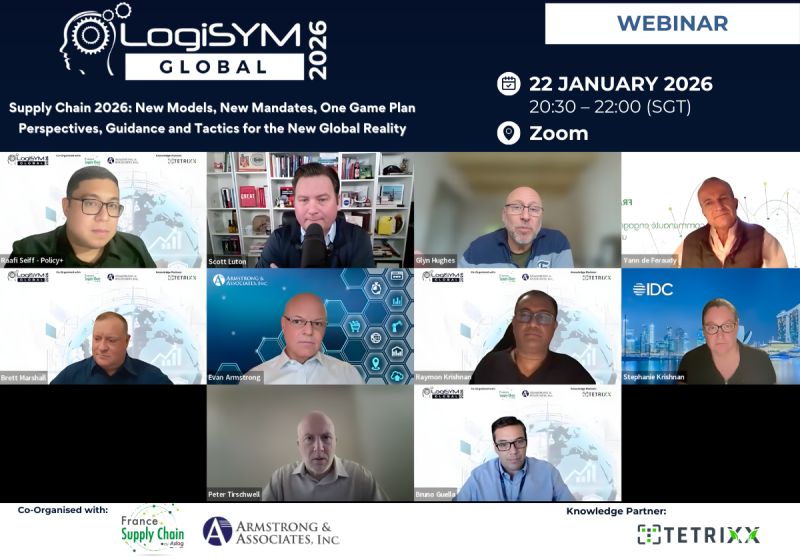
LogiSYM Global 2026 kicked off the LogiSYM calendar on 22 January with a high‑energy global webinar on the future of trade and supply chains, a stellar cast of panellists – Bruno Guella, Evan Armstrong, Glyn Hughes, Peter Tirschwell, Raafi Seiff, Scott Luton, Stephanie Krishnan, and Yann de Feraudy, and hosts Raymon Krishnan and Brett Marshall – attracting over 300 delegates across time zones. In a world shifting from rule‑based to power‑based trade, speakers agreed that resilience has become a structural requirement, not a defensive reaction. Event partners Tetrixx, France Supply Chain and Armstrong & Associates supported a stellar panel spanning policy, ocean and air freight, e‑commerce, technology, 3PLs and shipper communities.
Dr Raymon Krishnan framed 2026 as a “fragile calm” where geopolitics, tariff volatility under President Donald Trump, and shifting alliances are driving an evolution rather than one‑off disruption in global supply chains. Sector‑wise, panellists highlighted a challenging but opportunity‑rich year for air cargo, a resetting parcel/last‑mile landscape dominated by platforms like Amazon, accelerating 3PL consolidation and digitalisation, and a pivot in warehousing from expansion to sweating assets for efficiency. Strategic network shifts are visible in Canada’s diversification away from the US, intra‑Asia growth, and rising Asia–Latin America corridors, with ASEAN emerging as a major EU trading partner and “volatility eaten for breakfast” in the region.
Speakers showed how trade policy is rewiring flows in real time: US tariff and de‑minimis changes rapidly redirected China‑origin e‑commerce capacity from the US to Europe and Latin America, while Chinese platforms such as Temu and Shein are compressing lead times and re‑setting customer expectations. Data shared on US–China trade flows, the rise of Vietnam and other “China plus one” destinations, and record Chinese surpluses illustrated how both production (“China+1”) and consumption (“USA+1”) de‑risking are reshaping global manufacturing and logistics footprints.
Technology, AI and automation were presented as indispensable to cope with complexity—from digital twins and predictive analytics to robotics and AI agents in forwarding, brokerage and warehousing—but panellists repeatedly stressed that people, skills and governance remain the limiting factors. Boards and leaders are now being pushed to treat resilience—multi‑tier visibility, risk‑managed contracts, diversified networks and talent pipelines—as the core design principle for supply chains that must thrive in an increasingly power‑based, multi‑polar trading system.
Key Takeaways:
The next 12–24 months demand scenario planning, strategic foresight and closer ecosystem collaboration so that organizations can “prepare for what they do not know and look for what they cannot see.”
Resilience has shifted from a “nice to have” defensive posture to a structural design requirement for supply chains in a power‑based trade environment.
Geopolitics, tariff volatility and regional realignments mean disruption is now continuous evolution, not a one‑off shock.
Trade policy is actively reshaping flows: US tariffs and de‑minimis changes are redirecting China‑origin e‑commerce capacity across regions almost overnight.
“China+1/2/3” in production and “USA+1” in consumption are driving new manufacturing and routing footprints, with winners in ASEAN, India, Mexico, Latin America and others.
Freight forwarders and 3PLs benefit from complexity but must double down on digitalization, data, AI and strategic, not transactional, customer relationships.
E‑commerce platforms like Temu and Shein are redefining demand‑driven production, micro‑runs and lead‑time expectations, creating both efficiency gains and sustainability tensions.
Multi‑tier visibility and true transparency are becoming prerequisites for resilience, ESG compliance and managing mechanisms such as EU CBAM and evolving US tariffs.
AI and automation offer major gains in forecasting, planning, execution and emissions reduction, but only when anchored in clear business problems and robust data foundations.
Talent is a looming constraint: organizations risk a “talent cliff” if they rely on AI instead of systematically developing human capability and domain expertise.