

Two years ago, Top Transport Talent asked Japan’s logistics leaders what skills, people and technologies they would need for the future. Their answers look increasingly relevant today.
In 2024, Top Transport Talent surveyed 35 Country Managers and Directors across Japan’s logistics industry. More than 90% told us that a lack of qualified candidates was already their biggest recruitment barrier. Solution Sales and Key Account Management was the hardest talent to find, cited by 61.9% of respondents, followed by Field Sales at 52.38% and Supply Chain/Logistics Managers at 38.1%.
But we also asked a more interesting question: What would the logistics workforce need five years from now?
We are now two years into that five-year window. And the answers suggest that Japan’s workforce challenge is evolving from simply “Where do we find enough people?” towards a more complicated question:
How do we get more capability, judgement and productivity from a workforce that is becoming increasingly difficult to replace?
The skills logistics leaders predicted are becoming the skills that matter
Our 2024 research produced a striking result. When logistics executives were asked which capabilities would become most important during the following five years, they did not put technology first. They put communication first.
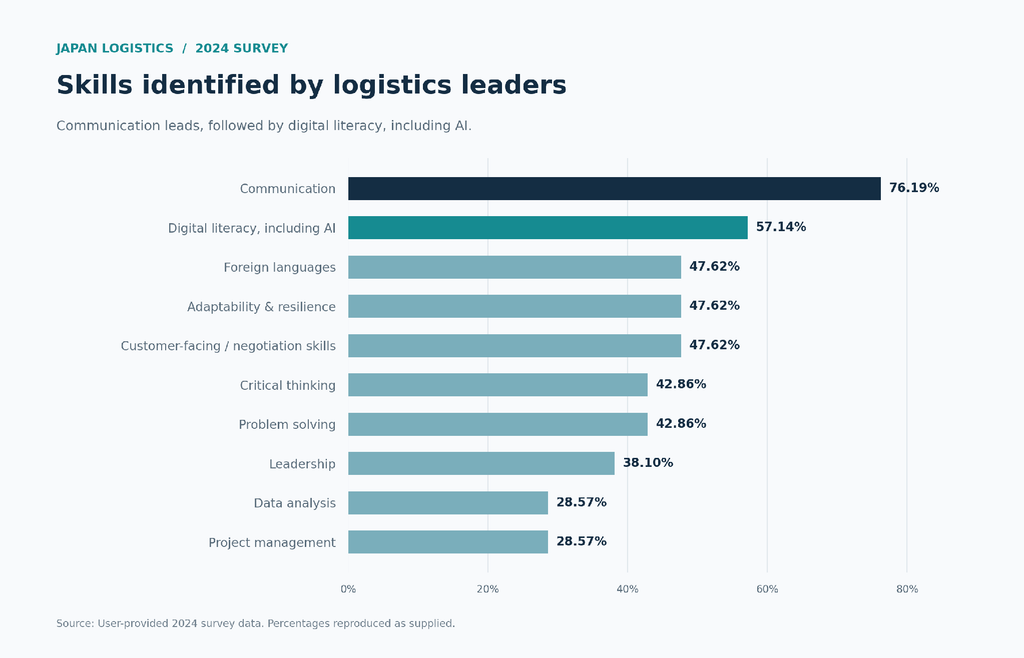
That combination is revealing. The workforce of the future is not simply a more technologically capable version of today’s workforce. It is a workforce in which technology capability and human judgement increasingly have to coexist.
A transport planner may receive an AI-generated route recommendation, but still needs enough operational knowledge to recognise that it overlooks a delivery restriction.
A customer-service employee can use AI to produce a shipment update in seconds, but still needs to recognise when an unhappy customer requires a conversation rather than another automated email.
A warehouse manager can have increasingly sophisticated productivity dashboards, but still needs to understand what the data does—and does not—tell them.
The skill is therefore not merely using technology. It is knowing when to trust it, when to question it and when human intervention is required.
Technology was supposed to help solve the labour problem. It still can.
Our 2024 survey also asked Japan’s logistics leaders which technologies offered the greatest potential to improve productivity and mitigate labour shortages. Their leading answers were:
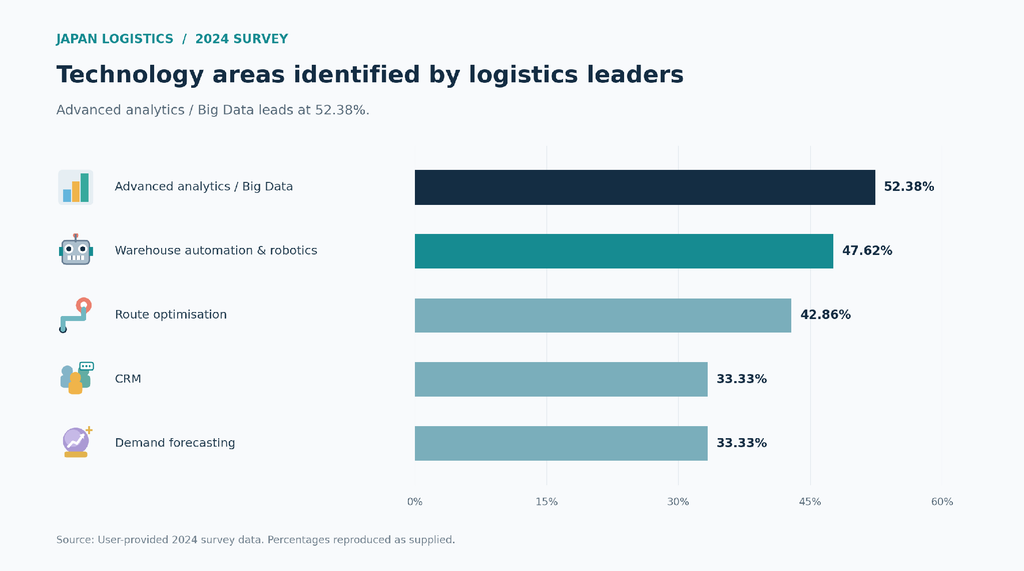
Since then, Generative AI has accelerated the conversation dramatically. But this creates an important distinction we explored in our recent CargoNow analysis, “Beyond the Hype: Is AI Really Making Shipping & Logistics More Productive?”
Saving time on a task is not necessarily the same as improving productivity across the business.
If technology makes administration faster, management still needs to determine whether the released capacity improves service, supports additional growth or genuinely reduces cost. That means the workforce question and the technology question can no longer be separated.
The relevant management question is no longer: “How many people can AI replace?”
It is: “How should we redesign work when people and technology can each do different parts of the job better?”
There is also a hidden risk: where will tomorrow’s experts come from?
Logistics has traditionally developed expertise through repetition. Junior employees make bookings, prepare documents, track shipments, investigate exceptions and gradually learn what can go wrong. Automation can remove much of that repetitive work. That sounds entirely positive—until we ask:
What happens to the learning that used to take place while doing it?
Our recent AI analysis raised precisely this issue: if junior employees increasingly approve AI-generated output rather than creating and investigating work themselves, companies need another mechanism through which they acquire operational judgement. Otherwise, companies could unintentionally automate away part of their management development pipeline.
That makes mentoring, exception reviews, simulations and supervised operational experience more—not less—important in an AI-enabled workplace.
Japan cannot recruit its way out of the problem
There is a second lesson from our original research. In 2024, companies were already attempting to expand the available talent pool:
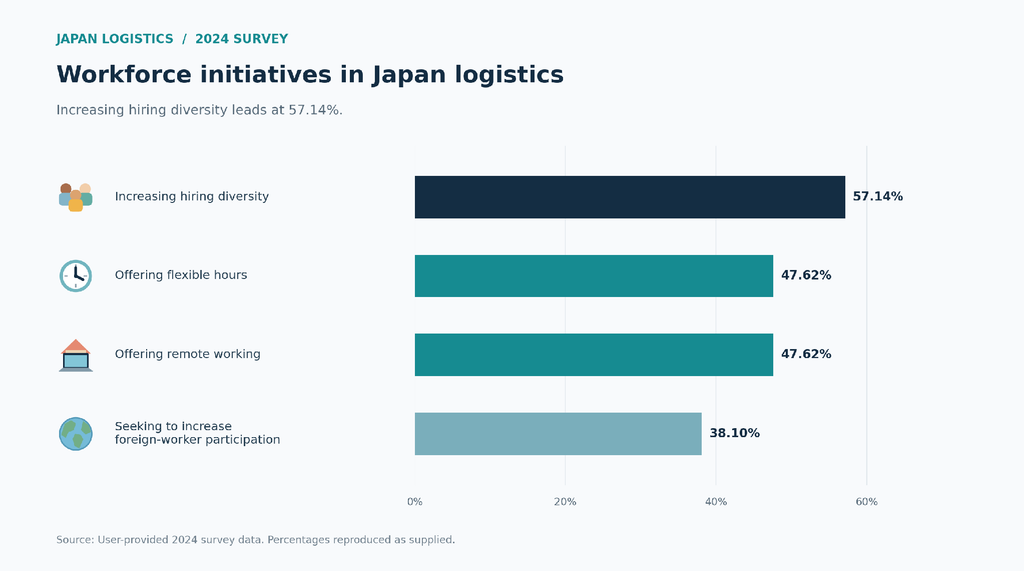
Those approaches remain important. But when more than 90% of an industry reports difficulty finding qualified talent, continuously competing for the same experienced candidates cannot be the entire solution. Companies have to become better at creating talent as well as buying it.
That requires a change in recruitment philosophy. Instead of asking whether somebody has already performed exactly the same job for a competitor, employers should separate:
What must this person know on Day One?
from
What could a capable person learn in six or twelve months?
That distinction potentially opens the market to candidates with transferable experience while protecting the
specialist requirements that genuinely matter.
English remains a particularly Japanese constraint
Our 2024 research found that the number-one recurring skills gap was English, followed by problem solving. This continues to create a particular challenge for international logistics companies in Japan.
Some positions genuinely require sophisticated Japanese for customers and negotiation together with English for regional or global communication. Others do not. Yet employers can easily write job descriptions requiring “business-level English” simply because that requirement has always been there.
The better question is: What communication does this person actually need to perform?
If English is essential every day, test for it. If it is used twice a month on a regional call, perhaps it can be developed. The same discipline should apply to systems experience, industry background and other specifications. In a constrained labour market, every unnecessary requirement reduces the available talent pool.
Retention is becoming workforce strategy
There was another strong signal in our 2024 data. 76.19% of surveyed logistics employers were already offering remote-working options and the same proportion flexible working hours. 57.14% were investing in training and development, while 42.86% were increasing base pay.
But when we asked what would matter in the future, employers anticipated greater emphasis on career development, mentoring, work-life balance, organisational culture, employee wellbeing and continuous feedback. That prediction is important.
Retention is no longer simply an HR metric. When experienced employees contain knowledge about customers, operational exceptions, local suppliers and recurring problems that cannot easily be replaced, retaining knowledge becomes an operational capability.
Companies therefore need visible career pathways. A Customer Service employee should be able to see a route towards Key Account Management. An operations specialist might move towards process improvement. A warehouse team leader might develop into automation or continuous improvement. Employees are more likely to imagine a future with an organisation when the organisation can show them what that future might actually look like.
And leadership may be the overlooked workforce skill
Our original research placed leadership below communication, digital capability and several other skills at 38.1%. Yet leadership may ultimately determine whether all the others succeed.
Being an excellent freight forwarder does not automatically make somebody an excellent manager. Front-line managers increasingly need to coach people, manage hybrid teams, introduce technology, handle performance, transfer knowledge and explain organisational change.
Regional leaders face another challenge: translating global initiatives into something that actually works in Japan. A process that appears efficient from Singapore, Hong Kong or European headquarters can create additional work locally if Japanese customer expectations, language requirements or operational realities were not considered during its design.
The future logistics leader therefore needs to operate in both directions: translate global strategy into local execution—and translate local reality back to global management.
From labour shortage to workforce redesign
When we conducted our research in 2024, the immediate issue was clear: Japan did not have enough logistics talent. That problem has not disappeared. But the next phase is broader.
People + Technology + Skills + Leadership + Better-designed work
Japan’s logistics companies cannot control demographics.
They can control how narrowly they recruit.
They can control whether employees receive meaningful training.
They can control whether technology removes work or improves it.
They can control whether experienced knowledge is transferred before people leave.
And they can control whether employees can see a career worth staying for.
Our 2024 research concluded that logistics employers needed to become more creative about hiring, invest in skills and provide increasingly personalised approaches to retention. Two years later, that conclusion looks less like a recommendation and more like an operating requirement.
The workforce of the future will not simply be recruited.
It will have to be built.
About the author

Wayne Yoshida
Managing Director · Top Transport Talent