

By Siva Devarakonda, CEO & Founder of Flexify.AI Inc.
Global logistics complexity, persistent material shortages, geopolitical tensions rising regulatory and cost pressures have put supply chains at a critical crossroads. Agentic AI—what many are calling the next frontier of automation—promises rapid, intelligent decisions that outpace traditional software approaches. Yet confusion abounds: is Agentic AI merely old software with a chat interface, or can it genuinely reshape supply chain operations?
In this article, we’ll explore:
- Why Agents are clashing with legacy SaaS approaches and confounding leaders
- The most pressing concerns supply chain executives face
- The current state of AI adoption
- Key technology trends that will drive future innovation
- Steps for leaders who want to act now, while AI solutions evolve
The AI vs. SaaS Dilemma: Why Leaders are Confused
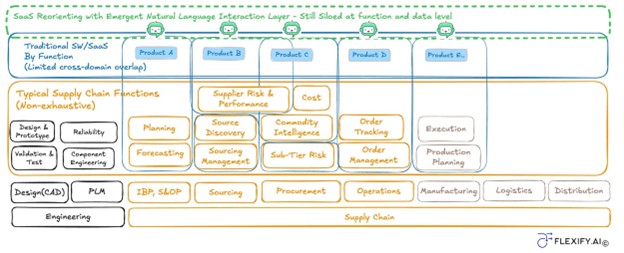
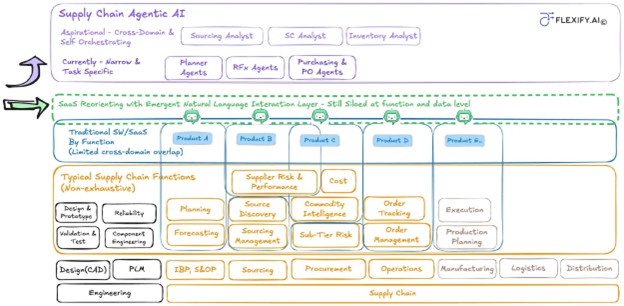
A common frustration among supply chain leaders is how quickly every software vendor has begun touting “AI-drivenˮ capabilities. Incumbent SaaS providers, in particular, are adding natural language chat interfaces to existing solutions, prompting scepticism:
“Isn’t this just the same old platform with a new UI?ˮ
AI Aspirations vs. Reality
- True Agency or Rule-Based Automation
Many “Agentic AIˮ products today focus on transaction automation based on preset rules rather than orchestrating multi-step decisions on their own. - New Startups Everywhere
Tech entrepreneurs are popping up with vertical “micro-solutionsˮ that claim to automate specific tasks—e.g., purchase order generation or supplier onboarding. This abundance of options overloads leaders, making it tough to discern hype from real innovation.
The Core Challenge: Leaders want more than a slick interface. They want systems that can recommend or even autonomously take strategic actions, not just replicate existing workflows.
Key Concerns from Supply Chain Executives
Despite excitement about the possibilities of AI, leaders must tackle several foundational issues:
- Data Readiness
AI’s potential hinges on clean, harmonised data. Many organisations realise their data quality—across ERP, PLM, and procurement systems—isn’t up to par. - Trust in AI Decision-Making
Will AI choose the right supplier or order quantity in ambiguous scenarios? Leaders want visibility into how AI reaches its conclusions and an option for human review. - Integrate with Legacy Systems or Rip and Replace Systems of Record?
Supply chain operations often run on multiple, decades-old platforms. Leaders are caught in an impasse of whether to do a full-scale replacement with a digital strategy or get incremental value which relies on integrations. - Security & Data Privacy
CIOs and CISOs worry about giving AI-driven tools access to sensitive internal and partner data. Clear governance and compliance frameworks must be in place, in many cases enterprise Generative AI policy is evolving cautiously. - Handling Complex, Non-Standard Processes
Supply chains frequently rely on human “tribal knowledgeˮ and glue processes. Leaders question if AI can adapt to these messy realities without extensive customisation. - Human Oversight & Workforce Impact
While AI could free up teams for more strategic tasks, the fear of job displacement lingers. Most leaders see AI as a “co-pilotˮ to accelerate decisions and reduce tedious work rather than replace people entirely.
The Current State of Evolution
Early-Stage Potential, Incremental Progress
- Limited Autonomy
Current AI agents are primarily narrow. They handle well-defined tasks (e.g., automated PO approvals), but no real benchmarks exist in demonstrating success with end-to-end orchestration. - Big Appetite for Pilot Projects
Many organisations want to start small—test AI in one part of the supply chain, measure impact, and expand from there.
AI as a Force Multiplier
- Shifting from Tactical to Strategic
With manual tasks automated, supply chain pros can focus on higher-value activities: supplier development, advanced scenario planning, and risk mitigation. - Scaling Decision-Making
AI can help scale cognitive capacity and by absorbing and responding to real-time data continuously.
Technology Trend – The Shrinking Gap between Intelligence and Action
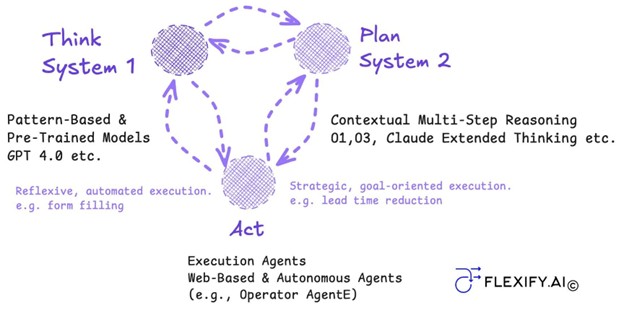
Perhaps the biggest promise of generative AI is narrowing the gap between predictive intelligence and rapid action. Enterprises have had their share of disillusionment with predictive analysis ultimately not leading to action that has measurable ROI.

Emerging frontier models allow us to combine vast external knowledge (GPT 4.0, 4.5), the power of advanced reasoners (like O1, O3, etc.) for analysis and scenario planning with operational orchestrators (like Operator, Agent-E, etc.) paving the way for real-time task automation and self-orchestration. This is rapidly reshaping the stack and shrinking the gap between intelligence, planning and action.
Pragmatic Path Forward
Frontier AI models offer increasingly advanced NLP and machine learning capabilities, hinting at self-orchestrated supply chain operations in the future—though true autonomy remains aspirational for now. Generative AI can cleanse and unify messy enterprise data, paving the way for more effective insights and recommendations. Meanwhile, cloud-native integrations and modernised infrastructure help organisations share data in real time, but also bring heightened focus to security and governance. Robust guardrails—including clear compliance standards, model auditing, and well-defined oversight—will be essential as AI maturity grows. A balanced approach as suggested here often works best:
- Pilot & Iterate: Tackle specific, high-volume tasks to validate ROI.
- Invest in Data Governance: Strengthen data quality and consistency.
- Establish Clear Governance & Guardrails: Define who oversees decisions and how data is secured.
- Focus on Workforce Enablement: Use AI to reduce repetitive work and address job concerns through transparent communication.
- Keep an Eye on the Ecosystem: Track both emerging startups and established players, ensuring your architecture remains flexible.
Conclusion
Agentic AI stands at the intersection of urgent supply chain demands and accelerating technological innovation. While it promises significant gains—from automating repetitive tasks to enabling faster, data-driven decisions—successful implementation requires careful planning around data, security, and governance. By starting with small, strategic pilots, solidifying data foundations, and empowering teams, organisations can build trust in AI and scale at the right pace. This measured approach ensures that investments align with a broader digital strategy, positioning the supply chain for greater resilience and competitive advantage in a volatile global landscape.
About the author

Siva Devarakonda
Chief Executive Officer and Founder · Flexify.AI Inc.