
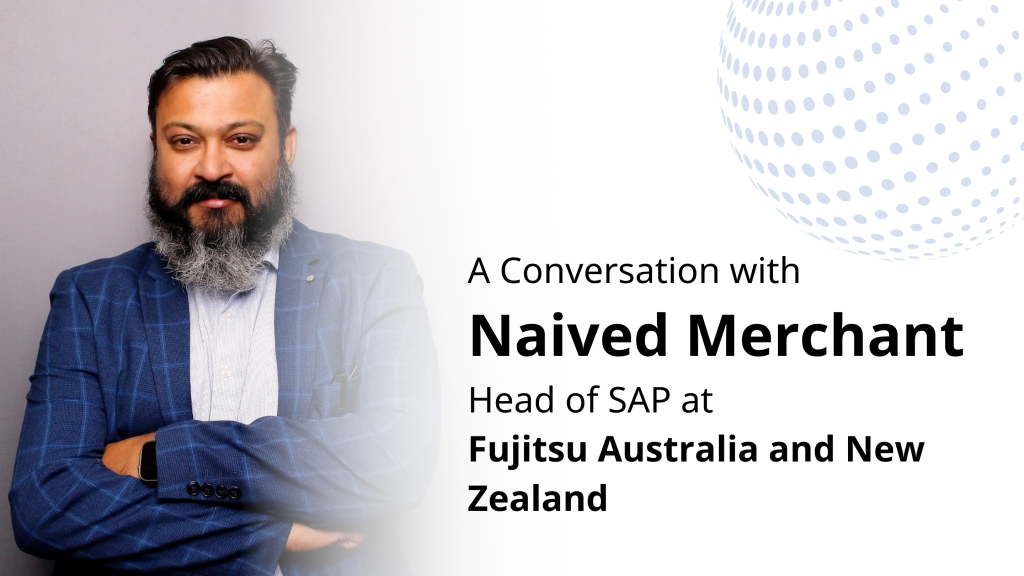
We had the opportunity to speak with Naived Merchant, Head of SAP at Fujitsu Australia and New Zealand, and an expert on Supply Chain.
In this exclusive interview, Naived shared interesting perspectives on the future of digital supply chains. He shared insights on AI, automation, and sustainability, emphasising real-time data, resilience, and meaningful action. Naived also highlighted key trends for 2025, the role of partnerships in digitisation, and how businesses across the UK & Ireland are adapting to digital transformation.
Tell us a little bit about your career journey thus far and what you do at Fujitsu.
My 25-year career in consulting and technology has focused on helping organisations optimise their operations and drive growth, particularly in Digital Supply Chain (DSC) management and ERP. This experience is now central to my role leading Fujitsu Oceania’s SAP practice.
Through our partnership with SAP, we work closely with our clients to understand their unique challenges, providing support across the entire SAP ecosystem, from implementation and optimisation to ongoing maintenance and support. A significant focus in recent years has been on building resilient and innovative digital supply chains, helping clients navigate the complexities and uncertainties of the current market. Fujitsu’s broader expertise in Asia Pacific, encompassing cloud, security, data, and enterprise solutions, allows us to provide comprehensive support for digital transformation for businesses and governments. It’s incredibly rewarding to see the positive impact our work has on our clients’ businesses.
We are at the start of 2025. What are some of your predictions or focus areas for 2025 from a Supply Chain perspective?
Global trade dynamics and international economic policies are evolving at a rapid pace. Enterprises will need to focus on the following five areas in 2025 from a supply chain perspective:
- AI and automation: Advanced AI capabilities will be increasingly integrated into supply chains to enhance operational efficiency and responsiveness. This includes using AI for better demand forecasting, inventory management, and optimising logistics.
- Sustainability: There will be a stronger emphasis on sustainable practices. Companies will focus on reducing their carbon footprint, using eco-friendly materials, and implementing circular economy principles.
- Resilience and risk management: Building resilient and anti-fragile supply chains will become a priority. This means creating systems that can quickly adapt to disruptions and recover from unforeseen events.
- Visibility and control: Enhanced visibility and control over the supply chain will be crucial. Technologies like digital twins and real-time tracking will provide better insights and control over inventory and logistics.
- Consolidation and M&A activity: The freight industry will see increased consolidation and mergers and acquisitions (M&A) activity. This will drive technology investment and expansion.
Key recommendations for supply chain professionals and logisticians to engage include:
- Build a data-driven enterprise with streamlined data from internal and external sources including business behavioural data, geographic influences, source and providence, etc., to improve decision-making regarding.
- Customers are demanding transparency about the origins of the products they consume and the socio-economic conditions under which they are produced. Investing in transparency and traceability across the supply chain including raw materials and labour, is a significant competitive edge.
- AI is a differentiator if used correctly but needs to be handled with caution. AI can simulate scenarios, predict outcomes, and optimise workloads if the right AI models are engaged but can be prone to bias if unchecked.
ESG and Sustainability are key areas of focus in supply chains today and many organisations say they spend more time reporting and not working on actual ways to make their supply chains more sustainable. What is your opinion on this?
Ultimately, sustainability is about action, not just reporting.
I think the concern about excessive reporting is valid. While reporting is essential for transparency and accountability, it shouldn’t overshadow the actual work of making supply chains more sustainable.
At Fujitsu, we believe in a balanced approach. Yes, we help our clients meet their reporting requirements, but our primary focus is on implementing practical solutions that drive real change. This includes:
- Optimising logistics: We leverage technology to optimise transportation routes, reduce fuel consumption, and minimise waste.
- Sourcing responsibly: We help clients source materials from sustainable and ethical suppliers, ensuring fair labour practices and environmental responsibility.
- Improving resource efficiency: We implement solutions that reduce energy consumption, minimise waste generation, and promote circular economy principles.
- Embedding sustainability into processes: We help clients embed sustainability considerations into their core supply chain processes, from planning and procurement to manufacturing and distribution.
Organisations must focus on initiatives that create tangible environmental and social benefits. By working together, we can build supply chains that are not only efficient and resilient but also sustainable and responsible.
How can Fujitsu help its partners overcome this hurdle?
Fujitsu helps partners overcome the hurdle of excessive reporting and to focus on tangible sustainability actions in several ways:
- Streamlining data collection and reporting: We leverage technology to automate data collection and reporting processes, reducing manual effort and ensuring accuracy. This frees up valuable time for partners to focus on implementing sustainability initiatives.
- Providing actionable insights: We go beyond basic reporting by providing partners with actionable insights derived from their data. This helps them identify areas for improvement, track progress, and demonstrate the impact of their sustainability efforts.
- Offering pre-built sustainability solutions: We offer a range of pre-built sustainability solutions that can be easily integrated into existing systems. This accelerates the implementation of sustainable practices and reduces the need for complex customisations.
- Providing expert guidance and support: Our team of experts provides guidance and support throughout the sustainability journey. We help partners define their goals, develop strategies, and implement solutions that align with their specific needs and priorities.
By partnering with Fujitsu, organisations can shift their focus from tedious reporting to meaningful action. We empower them to make their supply chains more sustainable, while also meeting their reporting obligations efficiently and effectively.
The ability to create the right partnerships with solution providers is often cited as a key to the success of digitisation projects. As a key enabler in this process what do you think helps make a good and successful partnership?
From my perspective, successful digitisation projects hinge on strong partnerships with solution providers. First and foremost, we need to be completely aligned on the strategic goal, business outcome, and project goals and how our combined strengths can achieve them. It’s about creating a shared vision from the get-go.
Clients prefer to engage partners to leverage the experience and expertise they offer. This is a key differentiator that can improve clients’ transformation journey.
Collaboration is key. We need to be willing to brainstorm solutions, solve problems, and adapt to changes together. Having clearly defined roles and responsibilities ensures everyone knows what’s expected of them, and it fosters mutual respect for each other’s expertise.
Open communication is vital. We need to be transparent with each other – sharing updates, challenges, and successes honestly. This builds trust, which is the bedrock of any successful collaboration. We need to be confident in each other’s capabilities and commitment.
Ultimately, the partnership should focus on creating value and achieving measurable outcomes. We need to build a relationship that goes beyond this one project, always striving for continuous improvement and learning from each other. That’s how we ensure long-term success.
How does Fujitsu help partners supercharge their supply chain with real-time visibility?
At Fujitsu, we help partners supercharge their supply chains with real-time visibility by leveraging our expertise in SAP solutions and our deep understanding of supply chain complexities. We offer a range of services and solutions that empower businesses to gain end-to-end visibility and control over their supply chain operations.
Firstly, we help integrate data from various sources, including ERP (Enterprise Resource Planning) systems, IoT (Internet of Things) devices, and external partners, into a centralised platform. This provides a single source of truth and real-time insights into inventory levels, production processes, and logistics.
Secondly, we leverage advanced analytics and AI to identify patterns, predict potential disruptions, and optimise decision-making. This allows businesses to proactively address issues, mitigate risks, and improve overall efficiency.
Thirdly, we offer solutions that enhance collaboration and communication across the supply chain ecosystem. This enables seamless information sharing, improved coordination, and faster response times to unexpected events.
By combining our technological expertise with our industry knowledge, we empower partners to achieve real-time visibility, improve agility, and build more resilient supply chains.
Industry 4.0 is an ‘old’ buzzword and so is digitalisation but what does this actually mean to Fujitsu?
Indeed, terms like ‘Industry 4.0’ and ‘digitalisation’ have been around for a while, and sometimes they can feel a bit overused. But at Fujitsu, we see them as more than just buzzwords. They represent a fundamental shift in how businesses operate and a real opportunity for our customers to transform and thrive.
For us, Industry 4.0 is about harnessing the power of digital technologies to create intelligent, connected, and ultimately more efficient operations. This includes everything from leveraging IoT and AI to optimise production processes, to implementing cloud-based solutions for greater agility and scalability.
Digitalisation, in our view, is about using these technologies to create new value and improve business outcomes. It’s about connecting people, processes, and data in new ways to drive innovation, enhance customer experiences, and ultimately achieve sustainable growth.
We’re not just talking about theory; we’re actively helping our clients put these concepts into practice. We’re implementing smart factories, building intelligent supply chains, and developing innovative digital solutions that address real-world challenges.
So, while the buzzwords may fade, the underlying principles of Industry 4.0 and digitalisation remain central to our approach at Fujitsu. We’re committed to helping our clients navigate this evolving landscape and unlock the full potential of these transformative technologies.
APAC is a very diverse region. Are there sub-geographic differences in the implementation and adoption of what Fujitsu is offering?
That’s a very astute observation. APAC is incredibly diverse, not just in terms of cultures and languages, but also in levels of digital maturity and economic development. And yes, absolutely, we see sub-geographic differences in the implementation and adoption of our offerings.
For instance, in more mature markets like Australia and Singapore, we see a strong focus on advanced technologies like AI and machine learning, and a greater emphasis on cloud adoption and digital transformation initiatives.
In contrast, some emerging economies in Southeast Asia may be earlier in their digitalisation journeys, with a greater focus on foundational technologies and building core digital infrastructure.
We recognise these nuances and tailor our approach accordingly. We work closely with clients to understand their specific needs and challenges, taking into account local market conditions, regulatory environments, and industry dynamics.
This might involve adapting our solutions to fit specific requirements, providing customised training and support, or collaborating with local partners to ensure successful implementation.
Our goal is to empower businesses across the APAC region, regardless of where they are in their digital transformation journey. We believe that technology can be a powerful enabler of growth and progress, and we’re committed to making it accessible to everyone.