

By Timothy Foote, Director Transportation & Network APAC at Asendia
It is 2025 and the transition away from fossil fuel is happening! Fully electric cars, bikes, scooters, buses, vans, and even trucks are on our roads. Solar panels are on rooftops, hillsides, and even on the water. Large wind farms are up and growing.
As we are already living through this period of transition, I wanted to take a look at the state of the global powers moving us forward. In history, countries that are at the forefront of energy transitions gain prosperity in greater amounts than the slower transitioning countries. This happened during the time of coal and steam as well as during oil and combustion engine transitions. Which countries are transitioning the fastest to green energy now?
I suggest that it is Asia that has the unique opportunity to establish that global leadership position in the coming years. To pull away from fossil fuels will not only provide Asia a healthier environment to live in, it will also provide it with a more secure, locally controlled, power source that is cheaper and cleaner than global competitors. Europe and the USA are also in the race though. As the world moves to the next sustainability milestone year of 2030 – which region will emerge as the global “green” leader? Read on, and I’ll share with you how this transition to green energy race is progressing.
Europe
So many sustainability conversations I have had in the industry circulate around the initiatives in Europe. How Europe has mandated 2% SAF for fuelling in their airports, for instance. On the ocean side, there are also regulations in place to drive higher quality for bunkers in ship fuel tanks. Both of these regulation changes improve air quality for the local residents as well as reduce emissions. More importantly, they are instituted in a way to provide an even playing field for the industry, because no carrier is given advantage over another.
Many European countries have made good progress in terms of recycling, green regulation, and recently in securing more sources and connections for greening their power grids. In the businesses I have worked in, European requirements have always been a reason for industry to act. Without Europe’s “standards driven” transition model, I have doubts whether the rest of the world would be at the level it is currently in terms of the energy transition now taking place.
Transition finance is also a key to Europe’s pivot away from fossil fuels. The REPowerEU program as well as others, has made significant progress in moving capital into green energy developments—especially since the end of the pandemic. The invasion of Ukraine brought even more determination in Europe to move away from fossil fuels. According to the European Investment Bank, in 2023 European countries spent 110 billion euros in renewable energy projects (https://www.eib.org/en/essays/europe-energy-transition-renewable). This was 10 times more than investments for fossil fuel.
USA
The new Trump administration shows nothing but disdain for green energy, and will have influence in slowing North America’s transition with actions he has already put in place in January. The stopping of funds for EV vehicle credits and much-needed EV charging infrastructure will slow the pace of change. That said, the United States and industry will continue to “green up” regardless. The economics of ever-lower costs of green energy will continue to propel things forward. This is what happened the first time around with Trump in charge, and the second time around should likely be the same. The damage Trump causes though may definitely take the USA out of a position to truly capitalise on the transition we are in today.
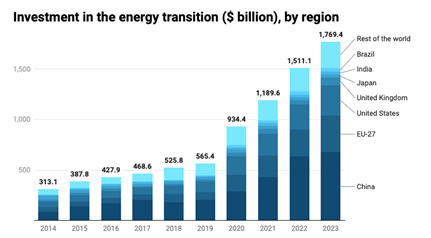
Asia Leaps to the Front
It is very clear when looking at the investment chart that investment in sustainable energy has been dominated by China as far back as 2014, and China accelerating that lead every year since. China’s demands for energy are, however, much greater than other areas of the world because it is the factory of the world.
Most nations in Southeast Asia, like China, have an advantage to speed our logistical transformation because EVs and sustainable shipping technology are built within our region. ASEAN countries have the ability to capitalise on China’s now-dominant sustainable energy know-how. Advantages for the ASEAN trade bloc, comes in the form of regionally controlled loan programs as well.
As the transition continues, share with me ideas on where you see Asia can increase its speed of change. Through 2025 the “Green Corridor” will be sharing the latest strategies and insights in our industry. If you can help to contribute with your own organisation’s experience, then please reach out to me.
About the author

Timothy Foote
Director Transportation & Network APAC · Founder · Asendia · Susymbio