

By Ashima Tyagi, Economics Associate Director, leading the Asian Pricing and Purchasing team at S&P Global Market Intelligence in Singapore
The economic landscape shaped by Donald Trump’s first term as President (2017-2021) of the United States (US) was marked by significant policy shifts that had lasting implications for both domestic and global markets. As President Trump embarks on his second term, it is anticipated that several of his policy positions will not only continue but may also expand. The emphasis on safeguarding American industries and redefining trade relationships is expected to persist. His administration’s hallmark initiatives in the first term included substantial tax cuts, a focus on deregulation, and an aggressive stance on trade, particularly with mainland China.
The Tax Cuts and Jobs Act of 2017 aimed to stimulate economic growth by lowering corporate tax rates, which initially spurred business investments and consumer spending. However, the trade tensions that ensued, particularly the imposition of tariffs on mainland Chinese goods, led to increased costs for consumers and created uncertainty in the market. His second term, however, will come with both new and renewed challenges, including inflationary pressures, supply chain disruptions, and intensified geopolitical tensions. These growing issues will challenge the economic strategies employed during his first term and create a more complex risk and pricing environment during the second term.
What’s Happening?
Trump tariffs and trade renegotiations are coming
While the narrative around the level of tariffs or their implementation process evolves every week, there will be no avoiding them under President Trump’s second term. The US President possess the authority to negotiate trade agreements and impose tariffs, especially in instances of trade injury. President Trump established a track record of using these powers during his first term in office using Section 232 to levy tariffs on imports of steel and aluminum under national security concerns; and Section 301 to levy tariffs on a broad list of imports from mainland China in response to “unfair trade practices”.
Although tariffs is an evolving story, on Feb. 1, US President has already issued executive orders under the International Emergency Economic Powers Act (IEEPA) citing immigration and narcotics flows to apply tariffs against imports from mainland China, Canada and Mexico. Since the announcement duties on Mexican and Canadian imports have been delayed at least one month; however, imports from mainland China will face new ad valorem tariffs with effect from Feb. 4.
What Could Come Next?
Mainland China will counteract
A potential push for US tariffs poses a significant risk to mainland China’s economy, especially if the initially proposed 60% tariffs across the board are implemented. Naturally, a counter-reaction from mainland China can be expected to mitigate the negative effects on its growth. It could take the form of a strong fiscal stimulus to spur domestic growth, loosen monetary policy further, initiate retaliatory trade measures, search for new trade partners to avoid tariffs or a combination of many of these options. As per the latest reports, Mainland China has already responded by placing 15% import duties on coal and natural gas and 10% duties on a range of oil, farm equipment, and vehicles effective Feb. 10. Prior to the implementation of tariff imposition in the US, frontloading of export orders from mainland China has already become evident towards the end of 2024 even though this may come at the cost of future demand.
President Trump’s first term unintentionally strengthened the trade and foreign investment ties between mainland China and both Mexico and Vietnam, as mainland China looked for new trade partners and alternative routes for its exports to access the US market. However, that option may not be viable in President Trump’s second term as both Mexico and Vietnam are already the target of Trump tariffs, given that a trade relationship with mainland China has been adequately established.
Rising costs for American businesses
During President Biden’s presidency, demand surged post-pandemic, while at the same time supply constraints led to heightened inflationary pressures. In response, the Federal Reserve adopted a more hawkish stance, hiking interest rates hikes to curb inflation. Under President Trump’s second term, the US monetary policy is likely to remain tighter for longer if high level of tariffs are imposed, that could also potentially hurt growth. In sectors such as steel and aluminium, the tariffs during the first term resulted in higher input costs for manufacturers even as capacity utilisation of domestic mills increased. This inevitably translated into increased prices for end products, affecting everything from automobiles to construction materials.
In analysing the market impact for 2025, the Pricing and Purchasing team at S&P Market Intelligence anticipates that the electronics industry will be one of the most vulnerable to tariff risks compared to other industries projected by the team. Under assumptions of 0% tariffs on imports from Canada and Mexico, a 30% tariff on all imports from mainland China, and a 10% tariff on imports from other markets, an increase of 6-8% in US’ electronics prices is anticipated by Q3-2025. Tariffs will result in stronger price escalation that will eventually subside by 2026. This forecast is predicated on a series of baseline assumptions, which are regularly updated on the basis of the most likely scenario.
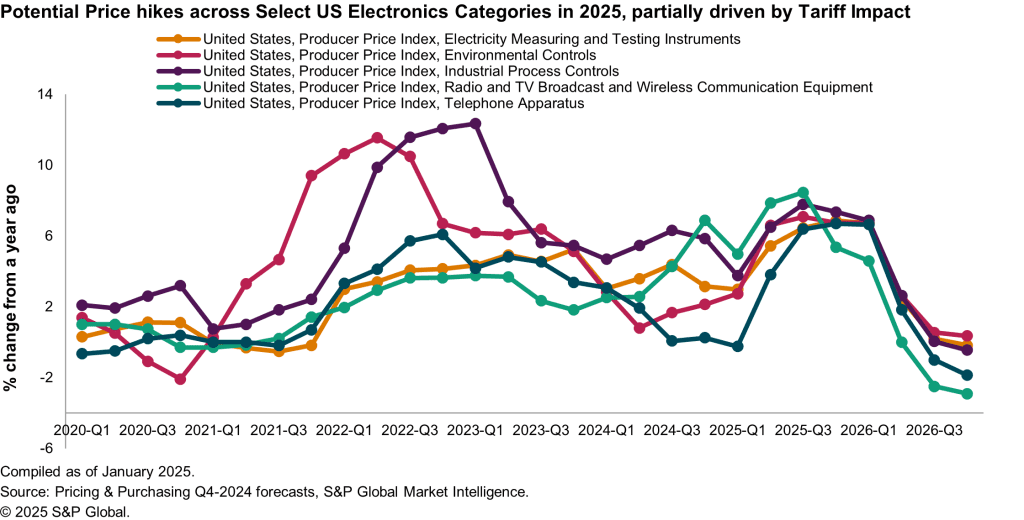
In the context of labour, S&P Global Market Intelligence also expects a tightening of US labour markets due to more stringent policies on legal migration, which will also have a direct bearing on operating costs. The industries that are likely to experience the most immediate impact include agriculture, construction, food processing, and food services.
Massive Repercussions on Currencies & Oil
A realignment of global supply chains is expected to accelerate, largely in reaction to President Trump’s proposed tariff hikes on mainland China. Asia-Pacific and Sub-Saharan African (SSA) currencies are expected to depreciate amid tighter global financial conditions and a stronger dollar negatively impact their inflation outlook.
Should tariffs increase during the second Trump term, it would likely have an adverse effect on global oil demand. Sluggish global oil demand growth may prolong the “cycle of surplus” that has defined the oil market over the past decade. At the same time, a reduction in federal policy support for electric vehicles could hinder the adoption of EVs, thereby acting as a counterbalancing factor that supports oil demand in the United States. According to S&P Global Commodity Insights’ research dated Nov. 2024, diesel fuel is more susceptible to the consequences of a higher-tariff environment compared to gasoline and jet fuel.
What Could Procurement Teams Do?
Calculate the costs being added
Considering the aforementioned scenarios, the risk landscape for businesses is anticipated to grow increasingly complex in the coming years. Consequently, procurement teams across global locations must remain agile, as they will need to navigate not only the evolving tariffs but also the uncertainties related to potential counteractive measures from trading partners. Teams could implement flexible procurement practices that allow for rapid adjustments in purchasing decisions. This might include negotiating contracts with flexible terms that permit changes in order quantities or delivery schedules without incurring significant penalties. Additionally, establishing a responsive supply chain that can quickly adjust to new information or market dynamics will also enhance agility.
Separately, procurement teams across the US must comprehend the costs being added to their Total Cost of Ownership (TCO) as a result of tariffs. Typically, TCO is generally divided into four categories: procurement costs, acquisition costs, usage costs, and end-of-life costs. When evaluating TCO in the supply chain, it is important to take your sourcing decisions into account. For example, many organisations may choose a higher minimum order quantity for a lower unit price. However, it’s essential to also consider inventory costs, the risk of obsolescence, and excess products in your total cost of ownership analysis. It is also important to consider lead times and supplier performance, along with potential supply chain disruptions, trade barriers, and any logistical costs. Assessing the stability of your supplier is crucial, as it may present risks if the procurement department is unable to import a product. All of these factors should be included when calculating your TCO.
Bottomline
The pricing and risk environment during President Trump’s second term will be characterised by a complex interplay of an ever-changing tariff landscape, trade policies, inflationary pressures, regulatory changes, and geopolitical risks. The tariffs are aimed at protecting American industry, but they will have a dual impact on pricing. While they will certainly provide a temporary shield for domestic US producers, they might also lead to increased costs for US-based importers unless exporters are willing to absorb a part of the tariff costs.
In the short term, procurement teams will need to effectively manage the impact of these tariffs by reducing exposure to cost fluctuations, through TCO analysis, negotiation with existing suppliers to absorb the additional tariff cost, entering into long-term contracts on fixed pricing, and monitoring regulatory changes. In the long run, businesses will need to adapt to tariffs by modifying their sourcing and production strategies, which may include managing inventory more effectively, relocating sourcing to tariff-free regions, or changing their approach to importing components for assembly instead of finished products.
About the author

Ashima Tyagi
Economics Associate Director, Asian Pricing & Purchasing · S&P Global Market Intelligence