
Chapter 1 (LogiSYM Magazine October 2026) examined the resource constraints – water, minerals, energy – that are ending the era of cheap inputs.
Chapter 2: Instability, AI and Production New Architecture
Part III. A World of Instability
The world is entering a phase of high turbulence. In the Global Risks Report 2026, geoeconomic confrontation ranked first among the risks for the next two years for the first time. In January 2026, the Doomsday Clock stood at 85 seconds to midnight-closer than ever before in history. According to Goldman Sachs, the geopolitical risk index has reached a 25-year high, surpassing the levels seen during the Cuban Missile Crisis and the September 11 terrorist attacks.
We are talking about several simultaneous hotspots of tension that will intensify through the end of the decade.
The New Map of Global Trade
Global trade, while continuing, is reshaping the economic landscape. Countries are stepping up protectionist policies: the U.S. Inflation Reduction Act allocates more than $400 billion to domestic manufacturing capacity; the European Net-Zero Industry Act and Critical Raw Materials Act aim to reduce dependence on imports; and India’s Production-Linked Incentive program focuses on localizing electronics and pharmaceuticals.
Nearshoring and friend-shoring are on the rise: alliances such as the Indo-Pacific Economic Framework and the Minerals Security Partnership are forming supply chains in politically friendly countries. According to WTO data, the number of trade restrictions has been steadily increasing since the mid-2010s and has accelerated since 2020.
The world is dividing ever more rapidly into opposing blocs, and countries are increasingly abandoning neutrality.
Risks Outside Insurance Coverage
Insured losses from natural disasters in 2024 reached approximately $137 billion. However, this is only part of the picture: total economic damage amounted to about $318 billion, and more than half of the losses remained uninsured. The rising cost of insurance is already limiting some regions’ access to capital.
Geopolitics adds a new layer of vulnerability: insurance policies typically exclude acts of war, and gaps in coverage become apparent only when a crisis strikes. For example, risk premiums in the Strait of Hormuz rose from 0.25% to 3–10% of a vessel’s value in 2026.
Pandemics remain a systemic risk: studies estimate the probability of a new pandemic on the scale of COVID-19 or larger in the coming decade at approximately 20%.
Force majeure events are becoming more frequent, and they are increasingly occurring simultaneously.
Financial Risks
Assets, management, and financing of manufacturing operations are increasingly distributed among different stakeholders. In 2025, Marelli, the largest supplier of automotive components (58 plants, supplying Nissan and Stellantis), filed for bankruptcy for the second time in three years due to $4.9 billion in debt accumulated following the company’s buyout by the private equity fund KKR. The plant continued to operate, but control over it passed to the creditors.
The owner of an asset does not always manage it, and the entity that manufactures the products does not necessarily own the production facilities.
Trust
In a world where decisions are increasingly made by algorithms, trust determines whether companies and systems can interact safely. It is built through algorithmic transparency, system resilience, the predictability of participants, and accountability for the decisions made.
Blind trust in a black box can lead to disaster. Because of a single bug in Fujitsu software, the UK Post Office falsely accused innocent employees of theft for years. Because of a single faulty CrowdStrike update in 2024, air travel, banks, and logistics operations around the world ground to a halt within hours.
Trust in algorithms is declining, especially when they are controlled by external partners. The key question is: Who is accountable for an algorithm’s decisions?
Part IV. An Intelligence-Driven Economy
The Era of Digital Agents
62% of organizations are already using or testing autonomous systems, mostly as decision support tools, but the next stage is AI shifting from an analytical tool to an autonomous participant in business processes. According to Gartner’s forecast, by 2028, AI agents will be involved in 90% of B2B procurement transactions with a total value of more than $15 trillion.
The next stage involves commercial transactions between autonomous agents. A new layer of control is guardian agents that check the actions of other systems, flag policy violations, and halt decisions that exceed their assigned authority. Gartner estimates such solutions will capture 10–15% of the procurement software market by 2030.
The agent-based architecture will be built around three tiers of responsibility: 1) agents execute routine transactions within defined limits; 2) guardian agents control their activities; 3) humans set the rules and handle exceptions. What matters here is not the speed of individual operations, but the ability to coordinate thousands of decisions simultaneously. At the same time, there must be a clear zone of responsibility for each decision; otherwise, an autonomous system becomes a system without an owner.
However, adherence to rules does not guarantee the quality of decisions. An agent may act formally correctly but make the wrong decision due to overly narrow boundaries of autonomy: for example, renewing a contract within budget but creating a long-term risk through unfavorable indexation. Therefore, designing the rules of autonomy becomes a separate engineering challenge.
There is also a more complex risk: the agent makes the correct decision based on distorted data. A falsified price, a fabricated supplier status, or false information about capacity can pass through all levels of control, since the rules have not been formally violated. Therefore, agentic procurement requires mandatory data auditing: the system must record what information the agent used, what rules it applied, and why it made the decision. Without this, a person will only be able to analyze the consequences of an error, not its source.
Data and Computing
Data is no longer merely a reporting tool; it has become a prerequisite for participation in global ecosystems. Companies lacking digital transparency are gradually losing access to markets and partner networks. At the same time, data sovereignty and AI laws are fragmenting the unified supply chain management model into regional circuits. The location where information is stored and processed is determined by legislation.
A similar process is occurring with computing power: chips, data centers, and energy are becoming strategic infrastructure. A country’s or company’s ability to obtain and utilize significant computing power will become as strategic a resource as access to oil, metals, or manufacturing facilities.
The Quantum Transformation
Technology is rapidly shifting from the category of opportunities to that of systemic threats. According to the Global Risks Report 2026, the risk associated with AI has risen from 30th to 5th place among 33 risks over a ten-year horizon.
One source of this risk is quantum computing. It has the potential to significantly accelerate the solution of problems involving routing, optimization, and resource allocation. At the same time, it creates a new level of technological inequality between those who have access to these capabilities and those who do not.
At the same time, cyber threats are on the rise: in 2025, 44% of confirmed data breaches were linked to ransomware attacks, compared to 32% the previous year. And quantum computing adds a threat for the future. Data stolen today may become decryptable as soon as such computing power becomes available.
Space
More than 10,000 active satellites already manage communications and navigation for global logistics; the global space economy reached $613 billion in 2024. Satellite systems have long been an integral part of global logistics and digital infrastructure: transportation navigation, real-time cargo tracking, synchronization of financial transactions, and monitoring of climate and geopolitical risks. The declining cost of launches is opening up a new niche-orbital delivery for selected cargo categories where time is measured in hours rather than days.
Part V. The New Architecture of Production
Decentralization and Robotization
Distributed manufacturing technologies are driving functional segmentation: raw material processing capacities remain concentrated, while final assembly shifts closer to the point of consumption. Manufacturing is transforming into a dynamic system where orders are distributed among nodes based on capacity availability, resources, and supply chain constraints.
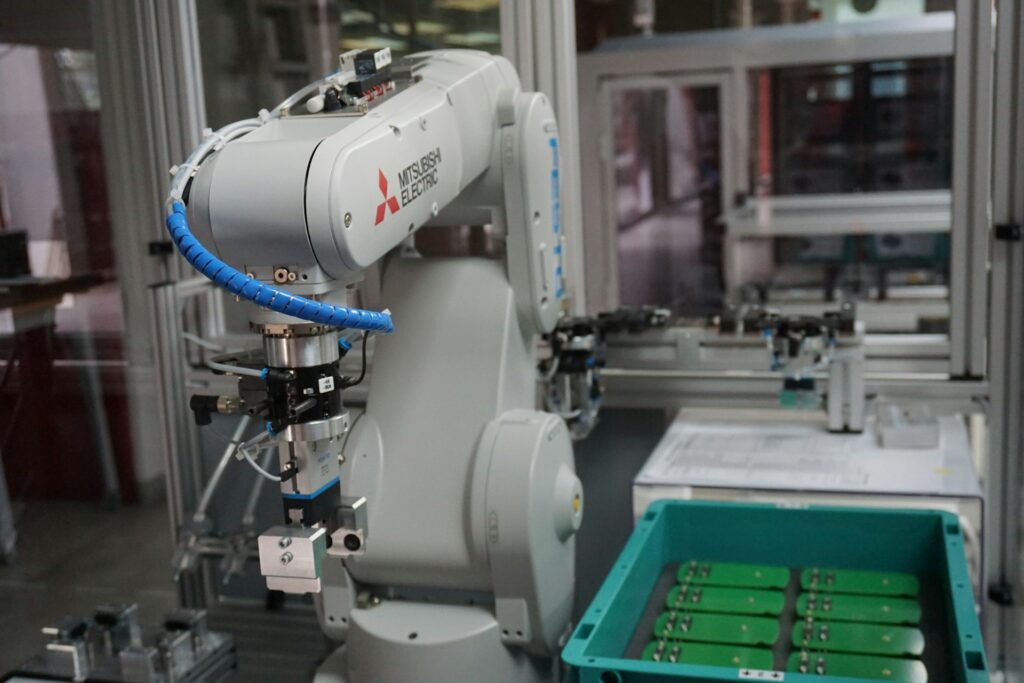
Previously, this shift was limited by technology and labor. Over the past decade, 3D printing, synthetic biology, and algorithmic materials design have moved from laboratories to industrial scale and become more accessible. Humanoid robots are removing the second barrier. Mass-customized assembly no longer depends on the availability of a large workforce. According to Barclays’ estimates, China could deploy up to 24 million robots by 2035, while Morgan Stanley’s scenario projects over 1 billion by 2050 (the upper limit of the estimate).
The Access Economy
The supplier becomes a system of manufacturers, platforms, and financial institutions operating as a single ecosystem, while contracts shift toward system-level agreements. Competitive advantage is determined by access to limited resources. Procurement begins to focus on acquiring production capacity rather than a fixed volume of output.
The next stage is the tokenization of access rights. Instead of purchasing a plant, one can reserve a share of its capacity-for example, a digital right to a portion of a smelting complex’s output or to specific hours of a production line’s operation. Tokenization transforms contracts into a liquid digital asset that can be transferred, aggregated, or used as collateral.
Continued in Chapter 3, LogiSYM Magazine December ’26/January ‘27: “From Trade-offs to a New Operating Model.”
About the author

Vera Rozanova
Procurement and Supply Chain Consultant · Self Employed