
by Dr. Albert Tan, Associate Professor and Academic Program Director – Asian Institute of Management, and Dr. Nursery Alfaridi Nasution, Lecturer and Head of Cooperative Affairs at ITL Trisakti and a tutor at Bina Nusantara University
Introduction
The global halal market is rapidly expanding, driven by increasing consumer demand for ethical and sustainable food products. However, ensuring halal compliance across complex supply chains remains a significant challenge due to fragmented information, difficulties in tracing product origins, and a lack of standardisation. Emerging technologies like Artificial Intelligence (AI) and blockchain are poised to transform the halal certification process, enhancing transparency, efficiency, and consumer trust.
As the world becomes more interconnected, halal supply chains must evolve to meet the expectations of a diverse consumer base. Traditional methods of halal certification, which rely heavily on manual inspections and paperwork, are increasingly proving inadequate in addressing modern-day supply chain complexities. The integration of AI and blockchain into halal certification processes presents an opportunity to revolutionise the industry, ensuring that products maintain integrity, compliance, and traceability.
The Challenge of Halal Compliance
Halal, meaning “permissible” in Arabic, extends beyond food restrictions to include ethical sourcing, production, and handling. Maintaining compliance throughout the supply chain is difficult due to:
- Lack of knowledge and awareness among stakeholders
- Risk of cross-contamination with non-halal products
- Complex and time-consuming certification processes
- Variability in global halal standards
- Fraudulent claims and misrepresentation of halal status
These challenges underscore the need for a holistic framework integrating modern digital technologies to ensure consistent and trustworthy halal certification. With increasing globalisation, ensuring halal integrity becomes even more complex, as ingredients are sourced from multiple regions, each with different regulatory frameworks. This fragmentation creates potential risks that may compromise the halal status of food products, making it imperative for businesses to adopt innovative solutions.
AI and Blockchain: A Game-Changer for Halal Certification
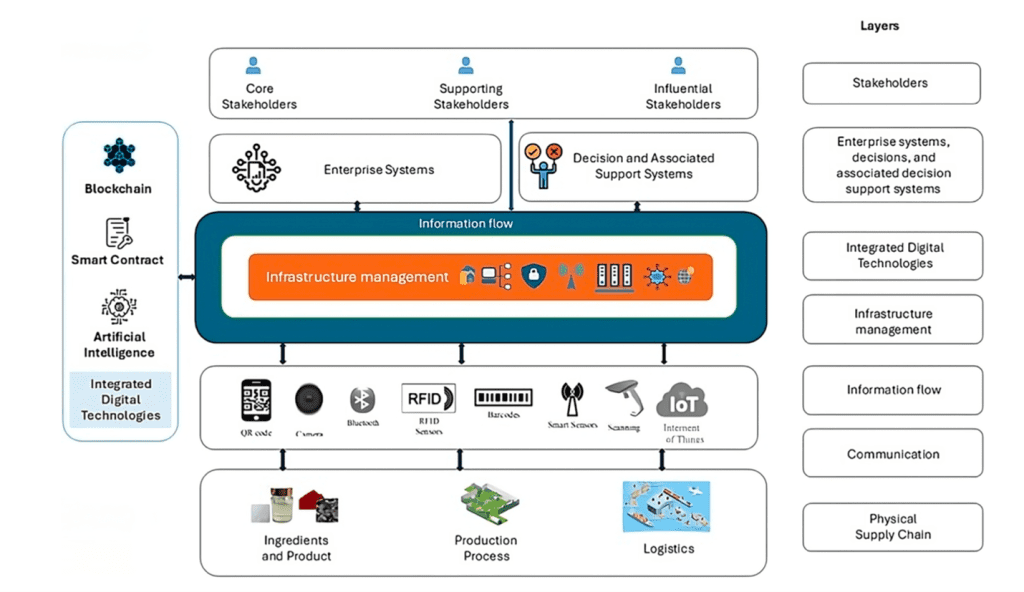
AI and blockchain technologies offer innovative solutions to the pressing issues in halal supply chains, as shown in figure 1. AI can automate compliance checks, detect anomalies, and analyse product ingredients for halal suitability. Blockchain, with its secure and immutable ledger, ensures product traceability from farm to fork, preventing fraud and enhancing consumer confidence.
These technologies are particularly valuable in markets where halal certification is scrutinised by regulators and consumers alike. For example, in countries with large Muslim populations such as Indonesia, Malaysia, and the Middle East, the demand for transparent and verifiable halal certification is higher than ever. AI and blockchain provide real-time verification mechanisms that ensure compliance with stringent halal standards, while also addressing the challenge of harmonising different halal regulations across jurisdictions.
How AI Enhances Halal Compliance
AI-driven systems can revolutionise halal certification by:
- Automating ingredient validation through machine learning models
- Using knowledge graphs to verify relationships between products, manufacturers, and certifications
- Employing predictive analytics to assess supply chain risks
- Enhancing regulatory compliance through AI-powered monitoring systems
Machine learning models can classify food products as halal or non-halal based on ingredient composition. Large language models (LLMs) like ChatGPT can further enhance transparency by explaining classification decisions in human-readable language, making the certification process more interpretable. Additionally, AI-driven systems can analyse large datasets from multiple suppliers and detect inconsistencies that might otherwise be overlooked by human inspectors. Furthermore, AI can assist in real-time monitoring of halal supply chains. Image recognition algorithms, for instance, can be used to detect non-halal contaminants in processing plants, ensuring that cross-contamination risks are minimised. AI-powered audits can also reduce the burden on certification bodies by streamlining inspections and flagging potential violations before they occur.
Blockchain for Traceability and Trust
Blockchain technology ensures halal product integrity by:
- Providing a decentralised, tamper-proof record of transactions
- Enabling smart contracts to automate compliance verification
- Enhancing transparency by allowing consumers to trace product origins
- Preventing fraudulent halal claims through secure authentication
For example, a smart contract could automatically validate whether a product meets halal standards based on blockchain-stored certification data. If an inconsistency arises, it triggers an alert for further review, reducing human error and administrative overhead. This decentralised verification system makes it more difficult for fraudulent claims to go undetected, ensuring that only truly halal-certified products reach consumers.
Blockchain facilitates cross-border halal trade by harmonising standards across different regulatory bodies. As a single, unified ledger accessible by all stakeholders, blockchain reduces discrepancies and inefficiencies that arise from varying certification processes. This can significantly boost consumer confidence in imported halal goods, as the blockchain provides an immutable record of every step in the supply chain.
Real-World Application: A Holistic Framework
A proposed AI-blockchain integrated framework for halal certification as shown in Figure 1. This framework represents a digitalised supply chain model that integrates blockchain, smart contracts, and artificial intelligence (AI) to enhance visibility, traceability, and decision-making. It consists of multiple layers, ranging from physical supply chain processes to stakeholder interactions and decision support systems.
At the top level, stakeholders are categorised into three groups: core stakeholders, who are directly involved in supply chain operations; supporting stakeholders, who assist in the execution of supply chain activities; and influential stakeholders, who play a role in decision-making and regulatory compliance.
Enterprise systems and decision support systems play a crucial role in managing business processes and integrating data. These systems provide the necessary tools to analyse information and assist in making strategic and operational decisions.
The integration of digital technologies further strengthens the framework. Blockchain ensures data security and transparency by creating immutable records of transactions. Smart contracts automate transactions and enforce agreements without the need for intermediaries. Artificial intelligence enhances data analytics and predictive decision-making, allowing for better forecasting and optimisation.
Infrastructure management oversees the communication networks, data flow, and system security, ensuring that information is transmitted efficiently and securely across the supply chain. The information flow layer facilitates the exchange of data between stakeholders, systems, and infrastructure, enabling seamless coordination and decision-making.
Communication technologies, including QR codes, cameras, Bluetooth, RFID sensors, barcodes, smart sensors, scanning, and the Internet of Things (IoT), enable real-time data collection and monitoring. These technologies provide critical insights into supply chain activities, allowing businesses to track products, monitor environmental conditions, and detect potential disruptions.
At the physical supply chain level, the framework covers three essential components. The first is the ingredients and product stage, which involves raw materials and finished goods. The second is the production process, where manufacturing or processing takes place. The third component is logistics, which ensures the transportation and distribution of products to their intended destinations.
Overall, this framework enhances supply chain efficiency by leveraging digital technologies to improve transparency, reduce fraud, ensure regulatory compliance, and enable predictive analytics. The integration of these advanced technologies supports real-time monitoring, ensures data integrity, and enhances decision-making, making it a valuable model for modern, resilient supply chains.
The Challenges in Adoption
The high costs of implementing AI and blockchain in halal supply chains can be a major challenge for businesses, limiting their ability to adopt these technologies. To address this issue, government support in the form of subsidies and financial incentives is crucial. By reducing the financial burden, businesses can more easily integrate digital halal certification systems, enhancing compliance, transparency, and efficiency across the supply chain. This approach not only facilitates industry growth but also ensures that halal certification remains accessible and reliable for global consumers.
The integration of blockchain in halal certification requires industry collaboration to develop standardised frameworks, ensuring consistency and transparency across supply chains. However, regulatory inconsistencies across different regions pose challenges in establishing uniform standards, making it essential for stakeholders to work together in harmonising certification criteria. Blockchain’s decentralised nature can help bridge these gaps by providing a universally accessible and tamper-proof system, but without regulatory alignment, its effectiveness remains limited. Therefore, a coordinated effort between governments, certification bodies, and industry leaders is crucial to overcoming these discrepancies and achieving a seamless halal certification process.
Many firms lack the necessary expertise to implement and manage AI and blockchain systems. Comprehensive training programmes and capacity-building initiatives are crucial to equipping businesses with the skills required for successful integration. Hence, providing targeted training programmes to stakeholders, addressing the complexities of AI and blockchain integration in halal supply chains, and equipping them with the necessary technological expertise to facilitate seamless adoption.
The Future of Halal Supply Chains
The integration of AI and blockchain in halal supply chains paves the way for greater transparency, efficiency, and consumer confidence. While challenges remain in terms of adoption and standardisation, the potential benefits far outweigh the hurdles. As regulatory bodies and industry stakeholders collaborate to embrace these technologies, the halal industry is set to become a model for digital transformation in ethical food production.
Future advancements in AI may allow for even greater automation in the halal certification process. AI-driven predictive analytics could help anticipate supply chain disruptions, while blockchain-based halal traceability systems could be integrated with mobile applications to provide consumers with instant verification of a product’s halal status.
The halal industry has a unique opportunity to be at the forefront of digital transformation. With the increasing demand for transparency in food production, AI and blockchain provide the ideal tools to uphold the integrity of halal certification while enhancing operational efficiency.
Conclusion
AI and blockchain are reshaping the future of halal certification, offering automated compliance verification, secure traceability, and enhanced consumer trust. By leveraging these technologies, businesses can ensure their products meet halal standards while optimising their supply chains. The future of halal supply chains is digital, transparent, and ready for the next wave of technological innovation.
As adoption grows, the global halal market will likely see improved regulatory coherence, reduced fraudulent activities, and heightened consumer confidence. The time to embrace AI and blockchain in halal certification is now, ensuring a secure, sustainable, and ethical future for halal supply chains worldwide.
About the authors

Albert Tan
Associate Professor & Academic Program Director · Asian Institute of Management

Dr Nursery Alfaridi Nasution
Lecturer and Head of Cooperative Affairs · ITL Trisakti