

by Simon Truss, Managing Partner at Top Transport Talent, and Wayne Yoshida, Senior Talent Acquisition and Attraction Manager at A.P. Moller – Maersk
Once bound by rigid traditions and long commutes, Japan is now undergoing a quiet revolution. The work-from-home (WFH) phenomenon has reshaped the nation’s work culture, catalysing dramatic changes in logistics and society. While adoption has been slower than in the West, the long-term effects are proving to be just as impactful—and the logistics sector is right at the heart of this transformation.
The Advantages of WFH in Japan
Remote work is more than just a trend—it’s unlocking opportunities that are reshaping industries and society.
Talent Attraction and Workforce Inclusion
WFH is proving to be a critical tool for addressing Japan’s labour shortages:
- Attracting Diverse Talent: Remote roles are opening doors for housewives, caregivers, and retirees, allowing them to balance work with personal responsibilities.
- Retaining Young Professionals: Flexibility and work-life balance are key demands from younger candidates, making WFH a competitive advantage in hiring.
- Tapping Regional Talent: Companies can now hire skilled professionals outside of urban centres, reducing reliance on Tokyo’s overcrowded labour market.
Productivity and Cost Savings
- Enhanced Efficiency: Workers save time and energy by avoiding long commutes, leading to improved focus and productivity.
- Lower Operational Costs: Companies can downsize office spaces and reduce overheads, freeing up resources for investment in technology and innovation.
Revitalising Rural Economies
- The Urban Exodus: WFH has encouraged city-dwellers to relocate to rural areas, boosting local economies and alleviating urban congestion.
- Decentralised Workforces: Logistics providers can optimise their networks to serve a more geographically distributed population.
Environmental Benefits
- Reduced Carbon Emissions: Fewer commutes mean lower CO₂ emissions, contributing to Japan’s sustainability goals.
- Eco-Friendly Logistics: Companies are rethinking delivery systems to align with greener practices, spurred by WFH-driven e-commerce growth.
The Resistance to WFH: A Cultural and Practical Pushback
Despite these clear benefits, resistance to remote work is growing among Japan’s more traditional corporations.
Cultural Challenges
- Face-to-Face Dependency: Japan’s business culture has long valued in-person interactions to build trust and maintain harmony. Senior executives often view remote work as undermining these principles.
- Hierarchical Norms: In a society that emphasises respect for authority, many managers are accustomed to direct supervision, which WFH disrupts.
Operational Concerns
- Collaboration and Innovation: Companies like Hitachi and Toyota argue that in-office interactions are crucial for brainstorming, mentoring, and maintaining team cohesion.
- Security Risks: Industries such as finance, represented by Mizuho Financial Group, highlight data confidentiality concerns as a barrier to full-scale WFH adoption.
High-Profile Examples
- Toyota: The automaker has limited WFH, emphasising the importance of hands-on collaboration for its complex operations.
- Mizuho Financial Group: After initially embracing remote work, the bank has scaled back, citing the need for in-office synergy.
- Fujitsu: Once a proponent of WFH, Fujitsu is now shifting towards a hybrid model that leans heavily on office attendance.
The Logistics Industry: A Case for WFH
In logistics, the benefits of embracing WFH far outweigh the challenges:
- Filling Labour Gaps: Flexible remote roles in customer service, IT, and operations attract new demographics to the workforce, including part-timers and freelancers.
- Improving Employee Retention: Companies offering WFH options are better positioned to retain talent in a highly competitive labour market.
- Boosting Agility: Remote work fosters innovation, helping logistics providers adapt to the explosive growth of e-commerce.
However, the industry must also navigate cultural resistance, ensuring that digital tools and management strategies are robust enough to maintain team cohesion and productivity.
Balancing the Scales: A New Path Forward
Japan’s WFH phenomenon presents a paradox: while it offers undeniable advantages, deep-seated cultural and operational resistance remains. The future likely lies in striking a balance between the two.
For Companies
- Adopt Hybrid Models: A blend of remote and in-office work can satisfy both traditionalists and modernists.
- Invest in Technology: Secure, seamless digital tools can address concerns about collaboration and data security.
- Promote Flexibility: Tailored WFH policies can attract diverse talent pools while respecting cultural norms.
For the Logistics Sector
- Lead by Example: Logistics companies can champion WFH by showcasing its potential to drive innovation and sustainability.
- Leverage Rural Opportunities: By aligning WFH with regional revitalisation efforts, logistics providers can unlock untapped markets and talent.
Further emphasising this trend, a survey by Nomura Research Institute indicated that the proportion of employees at large Tokyo companies commuting to the office daily fell to 47.4% in 2024 from 53.1% the previous year. Conversely, those working in the office three to four days per week increased to 26.5% from 22% in the same timeframe.
In response to these evolving work patterns, the Japanese government has been proactive in promoting telework. November 2024 was designated as “Telework Month,” during which the Ministry of Internal Affairs and Communications, in collaboration with other agencies, organised events and activities to encourage the adoption of flexible work styles.
Looking ahead, Japan is set to implement a four-day workweek for its 160,000 government employees starting in April 2025. This initiative aims to address the nation’s declining birth rate by providing citizens with more leisure time, potentially encouraging family growth. The move aligns with global trends where reduced workweeks have led to increased productivity and improved employee well-being.
In summary, while traditional remote work saw a slight decline in 2024, hybrid work models have gained traction in Japan. The government’s initiatives, including the promotion of telework and the introduction of a four-day workweek, reflect a commitment to fostering flexible work environments in the near future.
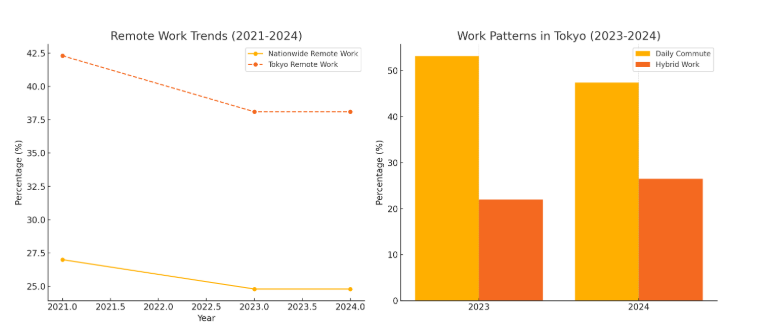
- Remote Work Trends (2021-2024): This line chart shows the percentage of employees working remotely nationwide and in Tokyo. Both have seen a slight decline over the years.
- Work Patterns in Tokyo (2023-2024): This bar chart compares the proportion of employees commuting daily to the office and those adopting hybrid work models. The shift towards hybrid work is evident.
Conclusion: An Evolving Transformation – Not a Revolution
The WFH changes are transforming Japan, but it’s not without its challenges. For every step forward, there’s resistance from traditional structures and cultural norms. The logistics industry, positioned at the nexus of these changes, has the opportunity to lead the way, demonstrating how WFH can drive efficiency, sustainability, and inclusivity.
Ultimately, the question isn’t whether Japan will embrace WFH—it’s how effectively it can balance progress with tradition. For industries willing to adapt, the rewards of this transformation could be monumental.
About the authors

Simon Truss
Managing Partner · Top Transport Talent

Wayne Yoshida
Managing Director · Top Transport Talent