

by Mark Millar International Keynote Speaker, Commissioned Author, Trusted Advisor and Supply Chain Thought Leader
Over recent decades, the story of globalisation has been one of ever-increasing complexity for global supply chains. Producers have shifted manufacturing from one low-cost location to the next – creating increasingly convoluted and complex global supply chain ecosystems. But ongoing disruptions and increasing uncertainty are now causing companies to rethink their supply chain strategies to adapt for the next chapter of globalisation.
Globalisation Context
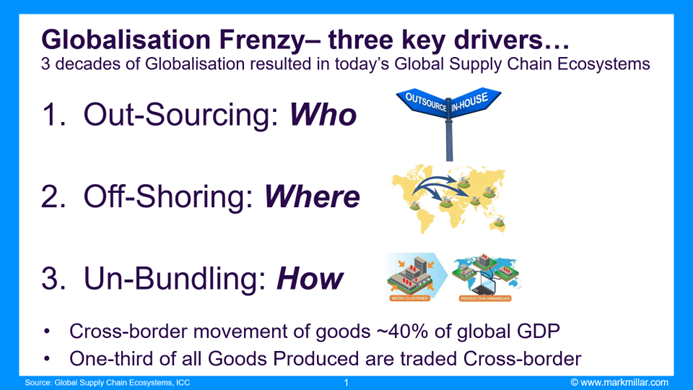
The globalisation frenzy was fuelled by an unprecedented combination of three key drivers in the pursuit of lowest-cost manufacturing: the out-sourcing of business activities to third parties; the off-shoring of production to low-cost labour markets; and the un-bundling of vertically integrated manufacturing clusters into dispersed specialist activities.
Capitalising on abundant supplies of low-cost labour, massive amounts of production were out-sourced, unbundled and offshored to emerging markets across Asia, empowering the region – in particular, China – to become the factory of the world.
Mass globalisation generated a substantial boost for international trade, resulting in huge increases in the volume of inter-continental freight flows and yielding a bonanza for logistics service providers and freight forwarders around the world.
Changing Landscape
Lately however, several factors have combined to produce a perfect storm for globalisation, brutally exposing the profound interdependencies and inherent risks of globalised supply chains and resulting in an ever evolving and increasingly complex landscape for producers.
Black swan events such as the Covid-19 Pandemic, the crisis in Ukraine and the unrest in the Middle East have caused massive disruption to goods flows and logistics networks.
Geopolitical tensions and domestic challenges are driving populist and protectionist government policies in the pursuit of ‘economic nationalism’. The ever-changing smorgasbord of trade tariffs is resulting in the need to reconsider the configuration of supply chains.
Rising labour rates in China and elsewhere across Asia have gradually diminished the manufacturing cost advantage of these locations, further exacerbated by the increased complexity and cost of intercontinental freight flows.
Supply Chain Reconfiguration
Many companies across the developed markets in the USA and Europe are now moving, or are considering moving, some of their off-shored production closer to home, known as ‘Near-Shoring’.
Others are undertaking ‘Onshoring’ initiatives – also called ‘Re-Shoring’ – which is bringing production all the way home, to produce locally within the domestic market.
Whatever the terminology, these initiatives involve the repatriation of manufacturing, production and assembly activities from remote locations such as China, to geographic regions located much closer to, or actually within, the end consumer market.
- OFF-SHORING: moving manufacturing and/or assembly activities overseas to low-cost countries based on labour rate differentials.
- NEAR-SHORING: moving manufacturing and/or assembling of products closer to the location of demand, where the products are consumed.
- ONSHORING (Re-Shoring): moving manufacturing and/or assembling of products back into the country of demand, where the products are consumed.
Near-shoring typically involves lower-cost locations that are in closer proximity to the final consumption markets – for example, Mexico for North America and countries like Poland, Hungary or Turkey to serve Western Europe. North Africa is now also on the agenda as a production base from which to serve the European markets.
Hence, for many businesses, there will be some production activities – though certainly not all – that migrate ‘closer to home’. Implementing such near-shoring initiatives will result in supply chains that are configured as ‘Made in North America for America’, or ‘Made in Eastern Europe for Europe’.
Logistics Consequences: Less Miles, More Moves, Modal Shifts
These supply chain shifts – beyond global, to a more regional approach – are key drivers in the changing landscape of globalisation, with important implications for every company involved in global logistics.
1. Shorter supply chains, fewer cargo miles, more journeys
As trade shifts beyond the established global networks to more regional supply chain ecosystems, the related cargo movements and freight flows will also have to change. The result will be less long-haul transport and more short-haul carriage, potentially generating some significant benefits for shippers – through using less fuel, saving costs and reducing emissions. As intra-regional trade flows grow, cargo movements will tend to involve shorter transit distances but are likely to generate a greater number of actual journeys.
2. Increase in domestic freight moves
The shifting globalisation landscape, involving more onshoring and re-shoring, will also increase the volume of domestic freight movements.
According to logistics investment adviser Stifel, when goods are imported into a country from overseas production facilities, the number of domestic transport moves is an average of 2-3 freight movements.
However, when products are produced entirely within a single country or continent, the freight is typically moved 8-12 times domestically; some four times as many as the number of domestic transport movements for imported products.
Great news for the local transport providers!
Therefore, in the new regional landscape, localised production will generate many more domestic cargo journeys, at the expense of long-haul international freight transport moves.
3. Modal shifts reflecting reduced speed differential
With the continued growth in intra-regional trade, the shorter transit distances involved will reduce the relative speed advantage of premium air freight over slower, cheaper modes of transport such as sea freight.
For example, in a global supply chain, transporting cargo across the trans-Pacific route would have substantial differences in door-to-door transit times between the air and ocean freight options – say 5-7 days by air freight, versus maybe 30-35 days by sea.
However, with the much shorter distances involved in a regional supply chain, the differential in transit time will be significantly less, a difference of maybe two-to-three days instead of two-to-three weeks. Compare a regional supply chain’s transit time by sea freight of just 5-7 days with 3-4 days by air freight. Consequently, the lower cost sea freight becomes a far more economically viable option in a regional supply chain.
Furthermore, many regional supply chains will involve large contiguous land masses – such as North America, western and eastern Europe and some of the Intra Asia region – in which case, cost-effective ground-based transportation options such as trucking and rail freight will come into play as competitive alternatives to air and sea freight.
Regional Supply Chains Drive Business Benefits
These near-shoring strategies will reinforce the trend towards more regional supply chains, which can generate substantial benefits for business – in terms of time, cost and service, whilst also reducing risk:
Benefits of Regional Supply Chains
- Shorter distances result in lower transportation costs
- Closer to home is easier to manage (overcoming some of the challenges of managing across time zones, languages, cultures, business practices and work standards)
- Better control over product quality through proximity to suppliers
- Mitigated impact of rapidly increasing labour rates in what were ‘low-cost’ environments
- Improved ability and responsiveness to tailor products for local domestic consumer markets
- Reduced supply chain risk: less distance, fewer borders, fewer complications, less risk.
The Next Chapter of Globalisation
Globalisation originally spurred enormous growth in international trade and a shift in business models, as companies rushed to take advantage of lower-cost overseas locations by out-sourcing, off-shoring and un-bundling their manufacturing and sourcing operations.
Now, the pendulum is shifting again.
Whether producers are reacting to the disruption arising from armed conflicts, applying lessons learned from the pandemic, responding to trade barriers resulting from populist domestic politics, or seeking to alleviate rising labour costs in China and elsewhere in Asia – the shift towards regional supply chains is unmistakable.
Indeed, the benefits of near-shoring are plentiful.
Yet the benefits of some low-cost manufacturing locations also remain compelling, particularly as we witness the gradual economic development of many emerging markets.
While some manufacturing operations will migrate ‘closer-to-home’ – speeding the shift towards regionalisation, numerous well-established and finely tuned global supply chains will remain in place, adapting over time to serve the expanding domestic market potential in many of the emerging economies across Asia.
In no way will there be a mass exit from Asia. Thirty years ago, the multinational companies came for the Workers, now they stay for the Shoppers!
The next chapter of globalisation for many businesses will likely involve a mix of multiple regional supply chains – with some ecosystems being near-shored closer to home, whilst others remain in place to serve the growth markets via ‘Made in Asia for Asia’ strategies.
Through to 2030, there will continue to be considerable volatility and uncertainty for global supply chains. But one thing is certain. Supply chain evolution will never fail to be interesting and will present both opportunities and challenges as companies grapple with the ever-changing landscape of globalisation.
About the author

Mark Millar
International Keynote Speaker, Commissioned Author, Trusted Advisor and Supply Chain Thought Leader · Global Supply Chain Ecosystems