
During these unprecedented times, it is technology that has come to the rescue of global supply chains. With airports and borders closed, ocean freight took center stage and emerged as the backbone of the supply chain ecosystem, keeping global trade afloat. The focus is now on how visibility cannot just make supply chains more resilient but also, help combat age old issues such as detention and demurrage.
COVID-19 has caused significant supply chain disruptions for businesses and consumers. From semiconductor chips in Singapore to potato chips in Thailand, companies have been forced to reconsider the viability of global production lines, as well as production methods like lean and Just-in-Time (JIT). Gartner estimates that 33% of firms have either moved sourcing and manufacturing activities out of China or plan to do so in the next two to three years.
Tech giants like Apple, Google, and Microsoft are similarly looking to diversify hardware production, including moving to locations within Southeast Asia (SEA). Through the adoption and use of visibility tools, better planning can ensue and help address the challenges around evolving supply chains and the global trade landscape.
What Does This Mean For Global Supply Chains?
Near shoring, re-shoring, offshoring is still the order of the day. Through these twists and turns on the world stage, the fundamental issues, challenges – and opportunities that exist however have not changed. Supply Chain professionals, be they shippers, freight forwarders, non-vessel owning common carriers (NVOCC), suppliers, and manufacturers still need to weigh efficiencies and effectiveness and evolve to meet market and organisational demands.
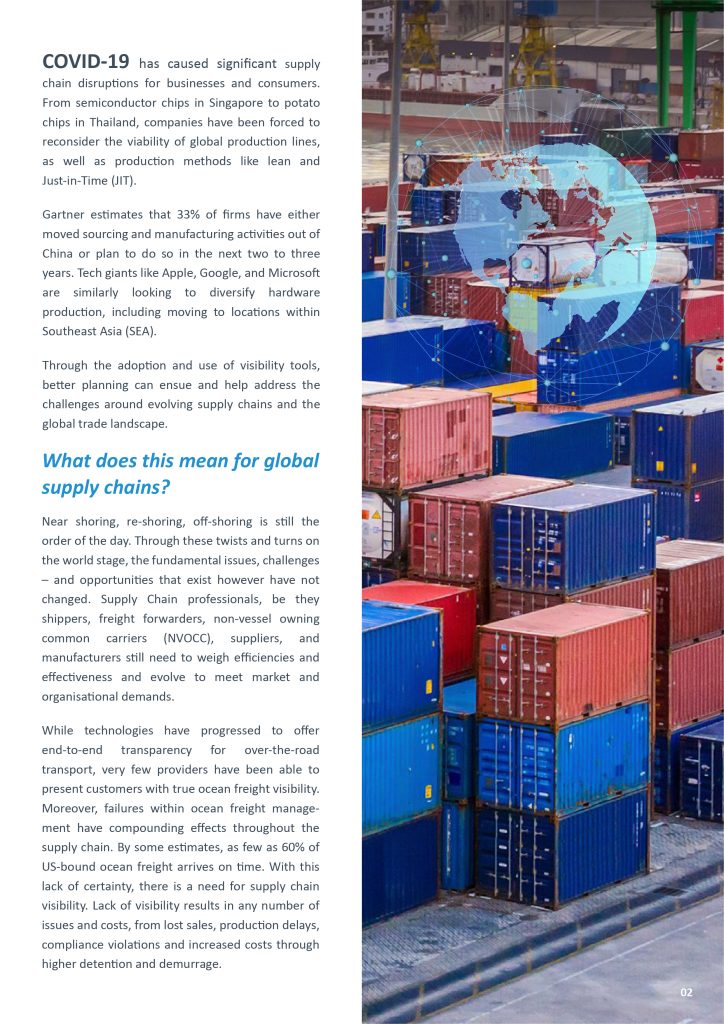
While technologies have progressed to offer end-to-end transparency for over-the-road transport, very few providers have been able to present customers with true ocean freight visibility. Moreover, failures within ocean freight management have compounding effects throughout the supply chain. By some estimates, as few as 60% of US-bound ocean freight arrives on time.
With this lack of certainty, there is a need for supply chain visibility. Lack of visibility results in any number of issues and costs, from lost sales, production delays, compliance violations and increased costs through higher detention and demurrage.
The Leading Benefits Of Better Visibility In Ocean Shipping
The original magazine chart compares the leading benefits reported by cargo owners and freight forwarders. See page 41 of the September 2020 issue. Chart credit: Ocean Insights.
Visibility Through Integration
Thousands of software companies exist to improve freight management practices. The use of a transportation management systems, warehouse management systems, warehouse execution systems, analytics platforms, and other systems are the products of software companies. Each system can benefit from more information about shipment status. Integrating these existing systems with a real-time capable tracking platform allows for real-time access and response to issues in freight management.
Moreover, the use of an API enables greater visibility through the supply chain, enabling software users to gain deeper insights into what the total landed cost of freight will be. This has immense value for improving customer service, keeping cargo spends under control, and maintaining sustainable operations.
The Ocean Insights Edge
Through the use of machine learning, with vessel tracking technology, integration with port management systems and ocean carriers augmented through human intelligence and analysis, Ocean Insights provides intelligence to shippers, BCOs, NVOCCs and Freight Forwarders alike.
Case Study – Hellmann Worldwide Logistics
Hellmann's client, an automaker was no longer willing to put up with conventional tracking and tracing (T&T) methods like calling forwarders to ask where a container was consulting a carrier's website where the information was unreliable. To provide the client with the required service Hellmann Worldwide Logistics had to know where a shipment was, calculate any possible delay, and inform the client accordingly.
This led Hellmann to research possible container T&T solutions and choose Ocean Insights (OI). Hellmann now uses OI's CTT web app to service the client's needs by feeding shipment-related data into OI's portal, downloading shipment status reports on a daily basis from that portal, and feeding the OI status report back to Hellmann's transport management system (TMS), which is connected by API with the client's TMS.
This way, Hellmann has been able to satisfy this client's challenging demands for complete supply chain transparency. By utilizing the T&T data from OI, Hellmann was able to provide two daily updates on all the U.S. automaker's in-transit containers along with a much more accurate ETA based on OI data. This has given Hellmann's client much more control over a shipment's availability and material planning, and enabled proactive action to minimize unnecessary additional costs.
Valuable Time Savings
In addition to all these client benefits, the OI tool is bringing Hellmann significant time savings. "We have to check 70 vessels twice a day," says Charles Li. "If we trace vessels on carrier websites, it takes approximately 5 minutes per vessel. That's 11.6 hours a day we're saving. And time is money! The savings adds up to a very fast ROI that paid off the cost of the software in less than a month". The CTT web app also helps avoid the manual input of data, and thus the risk of typos, missing data entries, etc.
This is particularly crucial for this client with their daily average of hundreds of ocean shipments in hundreds of containers on dozens of vessels in transit between APAC and the U.S.
Highly Accurate Data From Ocean Insights
Hellmann Logistics has been very satisfied with the accuracy of the OI data. The well-founded shipment data is now enabling Hellmann to update T&T faster and much more accurately than before.
Cost Avoidance And Optimisation
More than ever, costs are under scrutiny by shippers and forwarders and when times are as challenging as today, shippers and service providers are more mindful of this and need to be. This brings us to the issue of demurrage & detention – pain points and puzzles that the industry has been faced with for a long time. There are a few drivers of demurrage and detention: The idea behind demurrage and detention fees goes back to a simple concept.
Additional charges incentivise customers to stick to the schedule, and load/unload containers as quickly as possible. Unfortunately, that is only one portion of the equation. If delays occur, drivers may be unavailable to pick up freight. It’s not only just how quickly customers load and unload the freight, but it is also whether it can be completed safely. During the COVID-19 pandemic, we saw many origins and destinations limit the movement of vehicles and workers and therefore service providers were not able to operate.
Natural disruptions like floods, hurricanes, or other issues also affect and compound the types and possibilities of disruption in supply chains. This is a common problem. With that in mind, the fees themselves have reached a point of no return. According to the Journal of Commerce, U.S., demurrage and detention fees climbed steeply in 2014 and anecdotally, continues to do so.
Average penalties levied as part of demurrage and detention fees increased 90% in 2014 and another 86% in 2015. These levels settled in 2016, but they rose 30% in 2017, keeping costs well above the pre-2014 average. Depending on the volume of ocean freight, beneficial cargo owners may pay millions annually in demurrage and detention fees alone. Even among smaller customers, such as those moving as little as 500 containers per year, six-figure totals remain a commonality.
The good news is that tools now exist for forwarders and BCOs alike to help manage some of these issues.
Take Control Of Your Supply Chain
Although it is common and maybe even inevitable that you may incur demurrage and detention for your shipments, there are ways you can keep this to a minimum within your supply chain. With the advancement of Big Data, IoT and other track and trace technologies, shippers and service providers like freight forwarders and NVOCCs are empowered to have real-time visibility, all the time.
Data compiled from the entire shipping industry though the use of platforms like the one Ocean Insights offers, Ocean Insights are at the disposal to anyone within the supply chain ecosystem. The technology exists today to enable stakeholders to integrate business operations and make informed decisions that help drive down costs and increase control. The only question that should remain is: “why hasn’t your organization seized the opportunity to gain better visibility and mitigate fees?”.
The case study in this article highlights just how leading International Freight Forwarder, Hellmann Global Logistics, implemented a track and trace solution and achieved a fast ROI. There are many other ways and examples of how a good advanced ocean freight visibility tool can help you save thousands in detention and demurrage as well as provide other benefits and savings.
Originally published in LogiSYM Magazine, September 2020, pp. 40–44. Article and case study supplied by Ocean Insights.
About Ocean Insights
Headquartered in Germany, Ocean Insights is an ocean supply chain visibility and market intelligence provider supplying real-time tracking data and market analysis to shippers in automotive, manufacturing, food and beverage, commodity trading, chemical and freight forwarding. The company combines container liner schedules and carriers’ container tracking information with neutral AIS vessel tracking data.
About the author

Ocean Insights
Ocean visibility contributor · Ocean Insights