

Sustainability has become a boardroom priority. Net-zero commitments, ESG reporting, and regulatory pressure are now standard across industries. Yet for many organizations, sustainability remains more aspiration than execution. The gap isn’t intent; it’s decision-making. That’s where decision intelligence comes in.
Decision intelligence combines data science, artificial intelligence (AI), behavioral science, and decision theory to improve how organizations make decisions. At its core, decision intelligence bridges the gap between data insights and real-world actions, turning analytics into better choices and measurable outcomes.
Decision Intelligence represents the next evolution of data-driven management, integrating data science, artificial intelligence, and human expertise to optimize decision-making at scale. By embedding intelligence into every operational layer, fragmented data is transformed into strategic foresight and resilient execution. Rather than replacing human decision-makers, decision intelligence augments them. This provides contextual recommendations, risk evaluations, and scenario analyses that lead to better, faster, and more consistent outcomes.
Decision Intelligence and Sustainability
InterSystems surveyed 450 senior supply chain practitioners and stakeholders to examine key supply chain technology challenges, trends, and decision-making strategies across five common use cases: fulfillment optimization; demand sensing and forecasting; supply chain orchestration; production planning optimization; and environmental, social, and governance (ESG). These specific use cases illustrate how orchestration addresses unique supply chain scenarios and requirements. This article focuses on environmental, social, and governance (ESG) reporting and compliance.
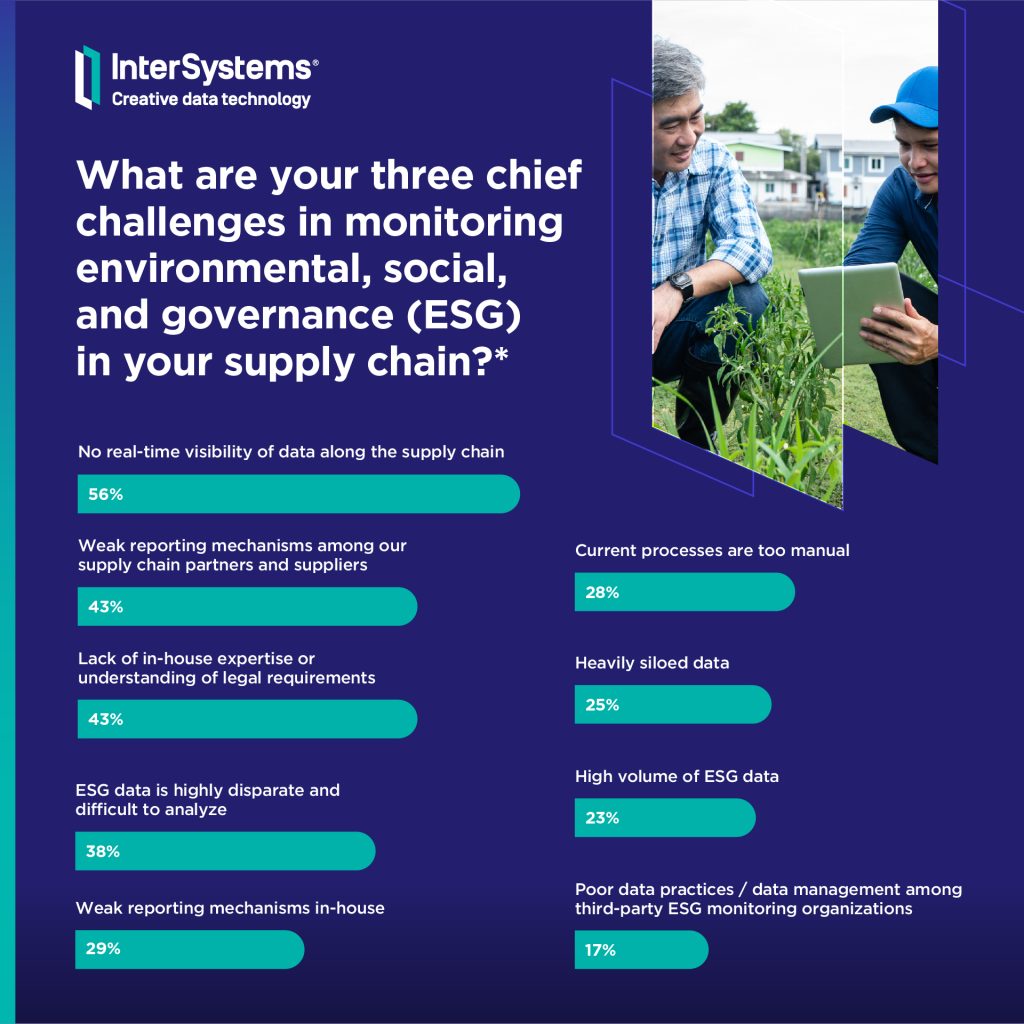
Survey respondents were asked to identify their chief challenges in monitoring ESG in their supply chain. The top challenge is a lack of real-time visibility of data along the supply chain. This lack of visibility doesn’t just create inefficiency; it directly undermines sustainability outcomes. Sustainability is driven by thousands of operational decisions, and without timely data, those decisions are made blindly.
A second challenge is weak reporting mechanisms among supply chain partners and suppliers. ESG data is difficult to harmonize, normalize, and make available in real time. As a result, organizations rely on historical data instead of what is actually happening. This leads to sustainability initiatives being reactive rather than proactive.
Survey respondents were also asked to rate their confidence in achieving ESG monitoring of their supply chain to be compliant with requirements within the next 12 months. Many of the top issues respondents face with ESG monitoring concern the lack of access to, or visibility of, necessary data. These data issues are impeding their ability to meet vital ESG monitoring requirements as just 12% of respondents are already compliant with requirements and only 26% of respondents are very confident, they will be compliant in the next 12 months. With financial penalties, as well as potential issues like reputational damage and operational impacts stemming from non-compliance, improving ESG reporting should be a priority for supply chain.
Lack of unified data in analytics contributes to even more challenges concerning ESG, most notably the carbon/greenhouse gas emissions in respondents’ own production processes, their suppliers’ operations, and their own logistics. In fact, when analyzed by size of organization, 75% of Fortune 500 companies report that carbon/greenhouse gas emissions in their own production processes is a top problem area for obtaining and analyzing data.
The Sustainability Problem Isn’t Strategy – It’s Decisions
Most organizations already know what they need to do around sustainability. This includes reducing emissions, minimizing waste, optimizing resource usage, and building resilient, ethical supply chains, among others. The challenge is how to execute these goals across thousands of daily operational decisions. Consider the following example:
Should a hospital substitute for a lower-cost but higher-emission supplier?
This is not an example of a high-level strategy question. It is the type of daily micro-decision that organizations have to make, often without visibility into sustainability trade-offs. Without a system to guide them, sustainability becomes inconsistent, reactive, and difficult to scale.
Decision intelligence operationalizes sustainability by embedding it directly into decision workflows. At its core, a decision intelligence platform does three things:
- Unifies data across the enterprise, creating a single, trusted foundation for decision-making. Sustainability data is notoriously fragmented, spread across supply chain systems, finance platforms, energy meters, and external partners. Decision intelligence integrates operational data (inventory, logistics, production), environmental data (emissions, energy use, waste), and external signals (supplier risk, regulatory changes, climate data).
- Models trade-offs in real time, shifting sustainability from a reporting exercise to a decision-making capability. Sustainability decisions are rarely binary. They involve trade-offs between cost, service levels, risk, and environmental impact. Decision intelligence uses machine learning to predict outcomes, optimization models to balance competing objectives, and simulation to test “what-if” scenarios. This enables a supply chain team to simulate lower-emission transportation routes versus delivery delays, supplier changes versus cost and risk impacts, or inventory strategies versus waste reduction.
- Drives action through recommendations for consistent, scalable decision-making aligned with sustainability goals. Insights alone don’t change outcomes; decisions do. Decision intelligence platforms generate predictions and optimization (e.g., lowest-emission sourcing plan), simulation and scenarios (e.g., impact of switching suppliers), and strategic recommendations (e.g., reallocate inventory to reduce spoilage).
From ESG Reporting to ESG Execution
Many organizations are still stuck in measurement mode: racking emissions, publishing reports, and setting targets. Decision intelligence enables the shift to execution mode. This mode includes embedding sustainability into daily operations, scaling decisions across the enterprise, and continuously improving outcomes. Essentially, it bridges the gap between knowing and doing.
Sustainability is ultimately the result of thousands of interconnected decisions. Without a system to guide those decisions, even the best strategies fall short. Decision intelligence provides that system. It connects data, models trade-offs, drives action, and learns over time, turning sustainability from a reporting requirement into a competitive advantage.
About the author

Chris Cunnane
Supply Chain Product Marketing Manager · InterSystems