
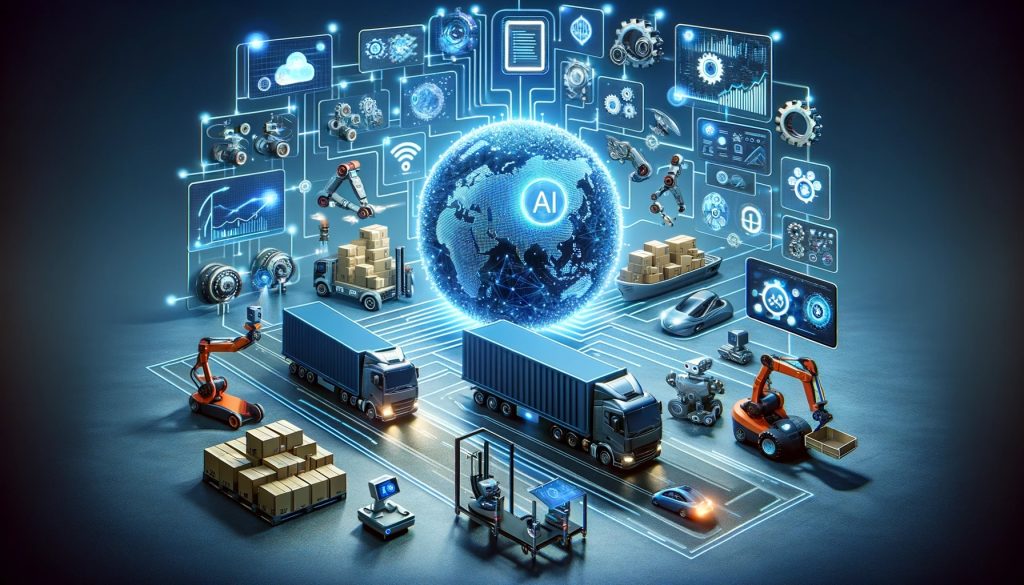

On a hot and rainy morning in 2035, the Port of Singapore hums without the clang of human hands. Autonomous cranes offload cargo. AI dispatchers orchestrate container movements like clockwork. In a glass tower, a human operator sits wearing an AI-augmented headset, overseeing one of the world’s busiest logistics hubs with the calm precision of an orchestra conductor.
This is not science fiction. This is one of the futures experts say is closing in fast.
As artificial intelligence, humanoid robots, robotics, and human augmentation technologies mature, the boundary between human and machine is no longer a question of tools but a question of identity. How much do we become machines ourselves? And for an industry like supply chain, which is the lifeblood of global commerce, the answer could rewrite everything from workforce roles to competitive advantage.
Three scenes illustrate what we mean when we speak about moving goods, managing fleets, or building the next logistics hub or digital platform.
Scenario 1: Augmented Symbiosis
AI and automation manage the execution of task-level activities, whereas humans—supported by augmented cognitive capabilities—focus on designing the plan and triggering its implementation. “Artificial intelligence is not a substitute for human intelligence; it is a tool to amplify human creativity and ingenuity,” says Dr. Fei-Fei Li, co-director of Stanford’s Human-Centered AI Institute¹. In the future, wearable AI, smart exoskeletons, and AR dashboards will be as common as forklifts today.
Picture it:
- Warehouse staff with augmented reality goggles overlaying pick-path optimization in real time: the mobile inventory control tower.
- Truck drivers using AI copilots that predict and avert weather-related delays hours before humans could spot them. Systems instantly replan and handle the freight space bookings.
In supply chains, augmentation turbocharges productivity without sidelining people. Predictive analytics cuts waste before it forms. Route-planning AIs shave millions off fuel costs. Autonomous pallet movers operate alongside humans, reducing injury rates.
Reskilling programs transform workers into AI managers and system supervisors. This world values human judgment and machine brilliance, with the two locked in a constant, productive dance.
Scenario 2: Full Automation — The Machine Runs Itself
Now imagine a bolder leap: AI and automation are taking over entire supply chain operations, from rerouting ships to negotiating supplier contracts. At the same time, humans shift into roles as exception-handlers and compliance overseers. According to the World Economic Forum’s Future of Jobs Report (2025)², AI and automation are poised to impact up to 60% of jobs across advanced economies by the 2030s or 2040s. While this sweeping figure covers all sectors and roles, not just those in supply chain and logistics, it underscores the profound transformation that lies ahead as human work increasingly intertwines with machine intelligence. We can expect that autonomous fleets, robotic warehouses, and AI procurement engines not only assist but also run entire networks.
Picture it:
- An autonomous ship reroutes itself mid-ocean to avoid a tariff shift — no human involved.
- An AI detects a potential raw material shortage in Vietnam and triggers an automatic supplier switch, not only finding new suppliers but negotiating the terms, placing the order, and rebooking the transport.
Efficiency soars. Costs plummet. But so do jobs. A McKinsey study³ warns that without aggressive retraining, millions could be stranded in the labor market. Ethical oversight becomes a critical and scarce skill set.
Yet, past automation waves have also created new jobs as old ones have vanished. Early factory mechanization displaced many workers but generated demand for operators, maintainers, and managers. Today, success hinges on keeping retraining aligned with the accelerating pace of change.
What else could go wrong?
- If the AI misinterprets data or fails to adapt to real-world nuances (e.g., geopolitical shifts, cultural factors, or supplier reliability), poor decisions may cascade through the network.
- Ethical oversight and compliance roles are minimal and often under-resourced. If the system violates regulations or environmental policies, it may go unnoticed until damage is done.
The logistical machine hums flawlessly until it does not. When it fails, humans must be ready to act in systems they no longer fully understand.
Scenario 3: The Human Identity Strain (The Paradox Made Personal)
The final future is less about technology itself and more about its effect on us. Whether the world moves toward augmented symbiosis or full automation, the risk is the same: the erosion of human purpose.
Consider Mei Lin, a logistics planner in Shenzhen in 2035. She spends her day taking “next‑best action” cues from an AI dashboard. Productivity is at a record high. Yet Mei feels like she is on autopilot. “Most days,” she admits, “I’m just here to agree with the AI.”
This is algorithmic alienation — when predictive systems fragment the self, erode agency, deskill human judgment, and drain motivation, leaving individuals estranged not only from their own choices but also from their colleagues and even their futures.
In this future, supply chain talent faces burnout not from physical strain, but from paradoxes made personal:
- The drive for efficiency undermines engagement.
- The quest for speed erodes resilience in human skills.
- The expansion of algorithmic control unsettles human trust in both systems and them.
Forward-thinking companies fight back by designing explainable AI that invites human challenge and scrutiny. They rotate employees into decision-heavy roles to keep judgment sharp, and track not just delivery KPIs but human engagement scores. Those who ignore identity strain may find their supply chain runs flawlessly while their people quietly hollow out.
The Strategic Paradoxes Supply Chain Leaders Must Navigate
The future of supply chains is not a simple choice between humans and machines, but a constant balancing act across tensions that cannot be fully resolved but must be managed (Figure 1). These paradoxes shape our decision:
- Speed and Efficiency vs. Resilience and Engagement: Supply chains pursue rapid, lean, and cost-efficient operations to stay competitive, but such systems can become brittle and vulnerable to disruption. Conversely, building resilience through flexibility, buffers, and human involvement safeguards against shocks but can slow processes and increase cost. The challenge is to navigate this tension dynamically, aiming for a balance rather than one extreme.
- Algorithmic Control vs. Human Trust and Agency: As AI systems take on more decision-making, the need for transparency, explainability, and human oversight grows. While automation drives scale and precision, human judgment remains essential for ethical, contextual, and strategic choices. Leaders must foster trust in AI while empowering workers to challenge and contribute meaningfully to its development and application.
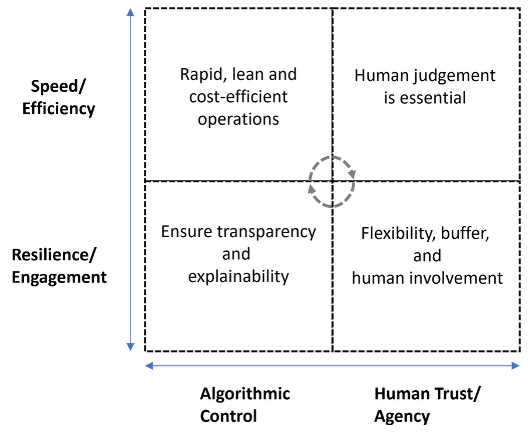
Figure 1: Strategic Paradoxes Framework
World-class leaders will not seek to eliminate these tensions; they will learn to live inside them, positioning their supply chain networks where speed and resilience coexist, with algorithmic control harmonized by human trust.
What Leaders Must Do Now
No matter which scenario emerges, or which hybrid takes shape, supply chain leaders face the same test: how to harness machine power without hollowing out human purpose. Three imperatives stand out:
- Redesign Work for Human-AI Synergy
Go beyond replacing jobs with machines. Define roles where humans exercise judgment, negotiation, and ethical foresight, while AI handles scale and precision. Future competitiveness depends on mastering this choreography, not just deploying technology. - Humanize Technology Through Transparency
Build AI systems that are explainable and open to challenge. Workers need to understand why recommendations are made to sustain trust and engagement, preventing blind faith in algorithms. Restoring human agency at the heart of digital workflows is critical for resilience and sound decision-making. - Build Adaptive Cultures, Not Just Efficient Systems
Measure well-being alongside traditional delivery metrics. Rotate employees through decision-heavy roles to maintain skills. Invest continuously in reskilling and scenario planning so the workforce is prepared for unpredictable futures that machines cannot fully foresee.
This framework guides leaders in navigating the paradoxical tensions that define modern supply chains, steering toward an “Augmented Harmony” where efficiency and resilience, algorithmic control and human trust, coexist dynamically.
Conclusion: The Choice Is Ours
The convergence of humans and machines in supply chains is not an inevitable destiny, but rather a design challenge and an opportunity. As the port of Singapore hums in 2035, it could embody the silent perfection of a brittle, fully automated system or the vibrant harmony of humans and technology working in trust. Navigating the paradoxes of speed and resilience, efficiency and engagement, and algorithmic control and human trust will determine which future emerges.
“So, I think it’s important that we’re making the right choices. It’s not that technology determines what happens. It really is us as a society choosing to set the right incentives for companies and invest in the right kinds of technology,” says MIT’s Kate Darling⁴. The hum we hear will not be chosen by algorithms alone; it will be selected by us, through conscious leadership, intentional design, and a commitment to preserving human purpose in the age of machines.
References:
¹“Top 10 Expert Quotes That Redefine the Future of AI Technology”, Nisum (www.nisum.com), Jul 25, 2023
²Henrik Ekelund, “Why there will be plenty of jobs in the future — even with artificial intelligence”, Jobs and the Future of Work, World Economic Forum, Feb26, 2024
³Pablo Illanes, Susan Lund, Mona Mourshed, Scott Rutherford, and Magnus Tyreman, “Retraining and reskilling workers in the age of automation”, McKinsey Global Institute, McKinsey & Co, Jan 22, 2018
⁴Dr. Kate Darling, “Robot Ethics and the Future of Human-Robot Interaction”, ISF Podcast YouTube S32 Ep7, International Security Forum, 25 Feb, 2025
About the authors

Wolfgang Lehmacher
Global Supply Chain Advisor & Former Director · World Economic Forum

Dr Richard Zhu
Global Partner · Spencer Stuart