
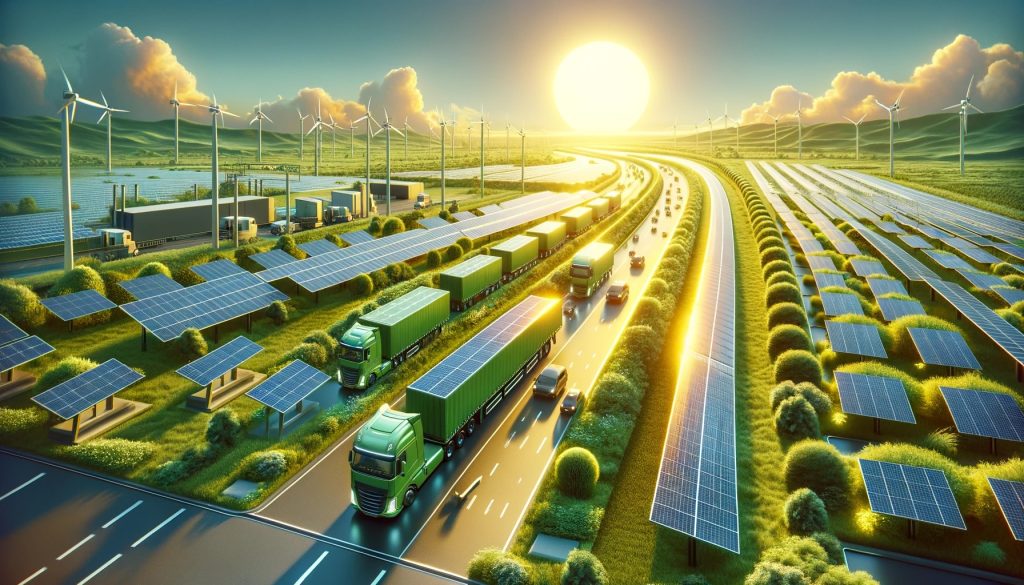

Logistics and Transport Problems Impeding a Green Future
When speaking to many in the industry, there is very often a feeling that true emissions-free logistics will only be achieved when there are new clean engines to replace the fossil fuel engines that make up the mass majority of fleets today. There are, however, other logistics challenges that also stand in the way of making a green future possible. This month I am not passing out information on the latest solutions but instead sharing one of the key logistics challenges that we have, in an effort to spur discussion and spur your creative juices towards a possible solution.
Hydrogen’s Logistics Challenge
Hydrogen is everywhere in our environment. Along with Oxygen it covers roughly 71% of the earth’s surface, not to mention the hydrogen contained in the air we breathe and the organic matter that makes up our terrestrial environment. That said, hydrogen is not an easy element to extract and isolate.
Hydrogen fuel, once extracted, can be used to power heavy industry as well as transportation. It has a lot of “bang” as a fuel (it is used in its liquid form to move rockets into space). But not all hydrogen fuel is sustainably manufactured.
This one reason why there are classifications of hydrogen used when discussing it. “Gray hydrogen” is hydrogen produced by burning fossil fuels. Blue hydrogen is a lower carbon emitting process as compared to gray hydrogen. Green hydrogen is produced using different methods. It could simply use solar or wind power to perform electrolysis or it could make hydrogen via chemical extraction of biomass using power supplied by renewable energy sources. In the end, green hydrogen is the lowest carbon emitting method for extracting hydrogen.
The “Green” in Green Hydrogen
For this article, I am going to concentrate on producing green using biomass gasification to produce hydrogen fuel. More details on the process can be found in the IEA document “Biomass gasification for hydrogen production” produced earlier this year¹.
Asian economies that produce lots of agricultural produce are rich in such biomass. So much biomass is produced that it is routinely burned every year in our region, causing air pollution and other environmental damage. It only seems prudent to make some use out of all the biomass currently burned, into something that will ultimately help the environment.
The Logistics Challenge
Efficiently getting the biomass to where it can be used is the logistics challenge. In a recent scientific report “Assessing the deployment of solar-driven hydrogen from biomass at scale in the U.S.”² which focused on the challenges to ramp up green hydrogen production in the U.S., researchers concluded that the main obstacle in the U.S. was a logistical one. Primarily, how to collect biomass in an efficient manner and then transport it to where there were large sources of green electricity to enable the processing of biomass into hydrogen. The U.S.’s situation will be similar to many mid-latitude regions that will see most of its wind and solar energy produced in dry and less agricultural regions. The distance between biomass and the energy-making sources creates a logistical challenge to move biomass hundreds or thousands of kilometers away at a low enough cost.
Southeast Asia does not have the same geography and power infrastructure as the U.S., but our green hydrogen making capabilities will also be challenged by distance and efficient collection. To give you an idea of the scale of biomass collection, it takes approximately 1 ton of dry biomass to produce 100 kilos of hydrogen.
How can South-East Asia do better? I leave that to our readers as an open question. As evidenced by the intermittent hazing that happens in the South-East Asia region, biomass is still being burned instead of being used for making hydrogen. What are the obstacles that we have for collection? How can a new green hydrogen producing systems be strategically installed to make use of our biomass instead of simply burning it? Please write to me if you are studying solutions for this logistical challenge, and I will be happy to share via our LogiSYM community.
¹ Joakim Lundgren, Berend Vreugdenhil, Yadi Ganjkhanlou, Robert Baldwin, “Biomass gasification for hydrogen production”, Technology Collaboration Programme, IEA Bioenergy, Feb, 2025
²Iloeje, C.O., Runchey, S., Gallier, A. et al. Assessing the deployment of solar-driven hydrogen from biomass at scale in the U.S.. Sci Rep 15, 14275 (2025). https://doi.org/10.1038/s41598-025-90290-y
About the author

Timothy Foote
Director Transportation & Network APAC · Founder · Asendia · Susymbio