

Poor IWT Detection in the Logistics and Supply Chain Industry is Killing Bio-diversity
Murder, robbery, hit and runs — these are crimes that hit the pages of local and international news everyday. Less publicized crimes are the those of the illegal wildlife trade (IWT). This is essentially the illegal capture and smuggling of our planet’s most endangered species over borders. The real life “snakes on a plane” type crime that endangers not only vulnerable species from extinction, but also our present and future health on this planet.
Victims in Our Midst
On a recent trip that I took to ACRES, it was once again highlighted to me that the evidence of continuing illegal wildlife trade and the cruelties involving with it are always easy to find. ACRES stands for the Animal Concerns Research & Education Society. This is a non-profit organisation that aids Singaporeans with the rescue and care for animal life that has either been trapped in our general living spaces or injured somehow by our urban infrastructure (for instance an owl that somehow get’s trapped in someone’s living room).
ACRES operates with compassion and care with the animal’s needs front of mind. During the course of their operations, they are often brought into scenarios where they need to rescue and care for wildlife that have been smuggled into Singapore and is now essentially trapped here. Denise (seen below) is just one example.
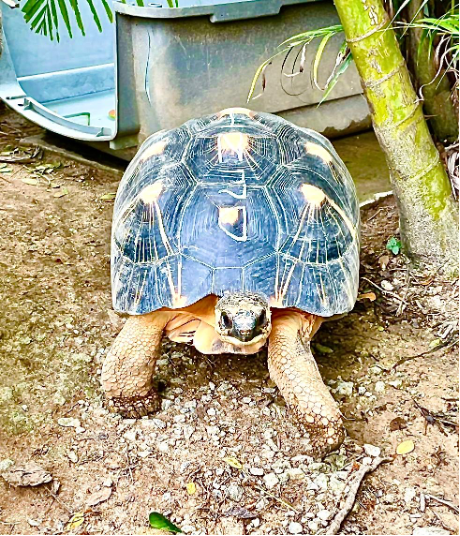
Walking the grounds of the ACRES Wildlife Rescue Centre in the West of Singapore, you will come across Denise. She’s just one among the many other rescued animals that the team there takes care of. Denise is a radiated tortoise from Madagascar, a critically endangered species not allowed for export from Madagascar, yet Denise is just one of four radiated tortoises that have found their way somehow to ACRES in Singapore. Indian star tortoises as well as many more rescued species are also at ACRES. Anbarasi Boopal, a good friend of mine who worked with these creatures for years, tells me the story of Denise and others. Working at ACRES for over 15 years, she knows all about the animal victims of IWT.
These animals are robbed from their native wilderness where they are then shipped out via parcels, luggage, personally carried or smuggled in larger consignments. They are transported to Singapore either by truck, plane or ship, sometimes hidden and sometimes simply mis-declared as a legal species of turtle as part of a wildlife shipment.
Many IWT collectors in Singapore keep the pets on their private property. Occasionally, when the turtles get bigger or become ill, the collector simply dumps the animal into the streets. In Denise’s case, luckily someone called ACRES to the rescue, and she was able to cared for by a trained wildlife care team. She is still at ACRES today because repatriation of wildlife is, to say the least, a complicated endeavour (it requires DNA tests amongst other challenges).
Collateral Killing
Denise is also lucky to be alive when you consider all the other animals that are killed in the IWT process. Animals in all parts of the world die in the course of being captured, handled, transported and finally forced into a life of captivity (nearly always by people with little specialised knowledge or concern with regards to the animals’ needs). Collectors as well often get in over their head when trying to take care of wild animal species because they are simply not sufficiently equipped or knowledgeable.
Smuggling Requires Transportation
The collection of IWT victims at ACRES and other wildlife sanctuaries, were all moved illegally via our very own logistics and supply chain industry. Rare and endangered species were packed (in parts or as a whole) into boxes, bills of lading arranged, commercial invoices made, and customs cleared via the global logistics system that we manage. For IWT sent in cargo shipments, in many cases the shipment appears as legitimate international movements of legitimate commodities. Unfortunately, the descriptions declared are simply fabricated.
A more notorious example of smugglers misdirecting authorities comes from the passenger travel industry. In 2010 a living tiger cub was found by Bangkok Customs in the luggage of a passenger/smuggler who declared to officials before the seizure that she was transporting toys!!
How NOT to be an enabler?
Two years ago, INTERPOL estimated the annual illegal wildlife trade to be a 20 billion dollar illegal business. Though it may be difficult to identify shipments that have intentionally fabricated contents, there are things we can do to prevent the shipment of IWT. In order to protect the remaining wildlife we have on this planet, and to fight against criminal organisations that profit from this trade, look into starting a program to detect and stop IWT.
Get trained! TRAFFIC Southeast Asia (a globally recognized NGO involved with fighting IWT) has courses for all cargo and passenger travel staffers. I spoke with Renee Yee who works for TRAFFIC Southeast Asia to see what is available. TRAFFIC Southeast Asia has worked with law enforcement, policy makers, conservationists and industry to record the moves of wildlife trade and as best they can, the illegal wildlife trade. With grants from USAID Routes program, they have put together training materials for employees working in our industry to detect IWT shipments. These are centered mostly on Air and Ocean transportation sectors. Currently, I am using some of those materials to enhance my organisation’s security training and procedures for our air parcel business. Renee can likely help you too. Just contact me, and I will do my best to link you up with her and TRAFFIC Southeast Asia’s training programs.
About the author

Timothy Foote
Director Transportation & Network APAC · Founder · Asendia · Susymbio