
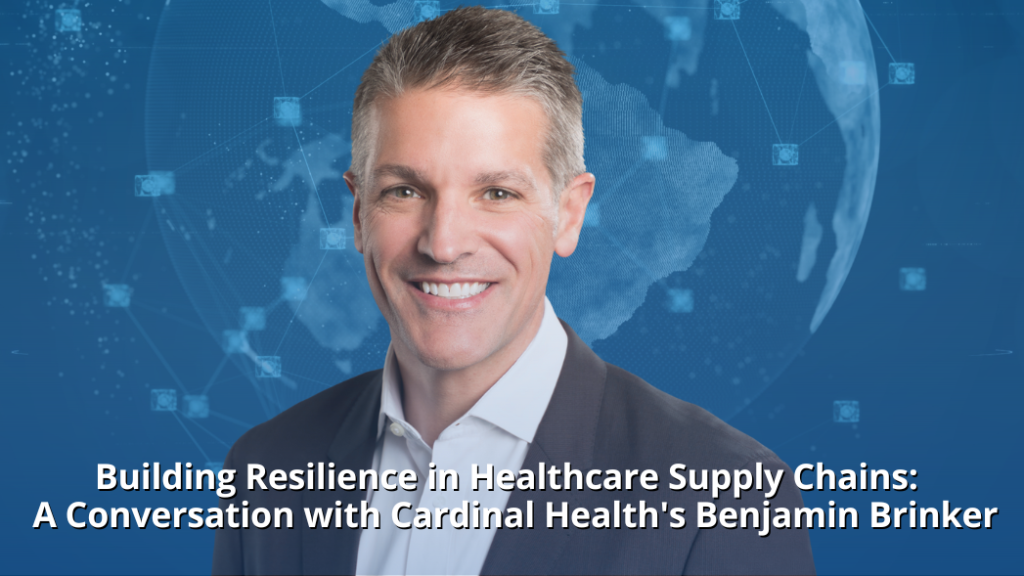
How one of healthcare’s largest distributors is leveraging AI, diversification, and regional hubs to navigate a post-pandemic world.
By Brett Marshall,
Editor in Chief, LogiSYM Magazine
In the complex world of medical device and pharmaceutical distribution, few have the vantage point of Ben Brinker, who oversees international operations for Cardinal Health’s Global Medical Products and Distribution business. With over 25 years in healthcare—spanning medical device sales, marketing, and now global operations – Brinker has witnessed firsthand how the pandemic fundamentally reshaped supply chain strategy. We sat down with him to discuss how Cardinal Health is building resilience through technology, supplier diversification, and strategic investments in Asia-Pacific operations.
From Marketing to Operations: A Career Journey
Q: You’ve spent 25 years navigating the evolution of healthcare distribution. What pivotal moments or decisions shaped your transition from commercial roles to leading global operations?
Brinker’s path to his current role reflects the evolution of healthcare distribution itself. Starting in medical device sales with Tyco Healthcare and later Covidien, he built his career in marketing and commercial roles, managing everything from at-home patient care to global product portfolios. His move to Medtronic brought exposure to globalization in wound care, thermometry, nutritional delivery, and deep vein thrombosis prevention compression therapy products, and when that business divested to Cardinal Health, Brinker came with it.
“I’ve been at Cardinal Health for almost nine years,” Brinker explains. “I started in marketing running global specialty products, which gave me a good sense of our global network.” The Cordis divestiture—a legacy Johnson & Johnson business—proved pivotal. “When that was divested, we had to reshape the international network commercially. I led the international team through that process, and for the last three years, I’ve been running the operations—which is new for me but a great experience.”

The Post-Pandemic Supply Chain Landscape
Q: The pandemic exposed vulnerabilities in healthcare supply chains globally. Three years later, which changes have proven permanent versus temporary, and what surprised you most about how the industry adapted?
The pandemic created permanent shifts in how medical distribution operates, according to Brinker. Three major trends stand out:
Heightened focus on service levels and disasterpreparedness.
“Pre-COVID, strategic product stockpiles and business continuity weren’t top-of-mind for all customers,” Brinker notes. “Now there’s heightened awareness and much deeper partnership around those topics.”
Product consolidation and deeper partnerships.
The industry has seen notable consolidation in products consumed, with partnerships deepening from device distribution to customers – whether hospitals or home care providers. “We have better provider partnerships now than pre-COVID, which supports our operations transformation,” he says.
Evolution in contracting methods.
The way Cardinal Health structures agreements with both suppliers and customers has fundamentally changed, reflecting new realities around supply volatility and risk management.
AI-Driven Supply and Demand Planning
Q: Cardinal Health has invested significantly in AI and automation. Can you quantify the impact – what specific metrics improved, and were there any unexpected consequences or limitations you encountered?
While IoT and GPS tracking have found applications – especially around sterilization monitoring and lot tracking – Brinker identifies AI-generated insights as a transformative technology investment.
“The biggest benefit we’ve seen is from AI in supply and demand planning,” he explains.
“We’ve made significant investments in advanced models that have improved our service levels, reduced backorders, and balanced our inventories globally.”
This represents a fundamental shift in Cardinal Health’s operating model. “We’ve moved from a very US-focused approach to a more globally balanced inventory and planning approach,” Brinker says. The AI system links forecasts to forward deployment of inventory based on expected needs, enabling proactive rather than reactive responses.
Q: What resistance did you encounter internally when proposing AI investments, and how did you build the business case?
Cardinal Health partnered with a technology provider whose planning system uses AI analytics to position products optimally across their global network. “AI helps us with disaster prevention,” Brinker emphasizes. “It allows better response than our previous manual processes by predicting where products need to be before demand spikes occur.”
Direct-to-Patient Distribution: Technology Meets Logistics
Q: Given the shift toward home-based care, how is Cardinal addressing the growing direct-to-patient delivery trend, and what percentage of your business does this represent?
The shift from institutional to home-based care presents unique challenges. Demand volatility at home is far greater than in institutional settings, requiring different distribution strategies. “We use a hub and spoke model to help ensure more even deployment of products,” Brinker explains.

Technology and automation deployed within our distribution sites lower costs for small-order picking.” This automation is crucial for parcel shipments—traditional distributors without it have failed to compete effectively.
Interestingly, this technology is influencing traditional business as well. “We’re seeing increased demand for customization even in our institutional business,” he notes, suggesting convergence between B2B and B2C fulfillment strategies.
Q: Are hospital customers evolving their supply chain capabilities?
They are, particularly in North America, but increasingly they rely on Cardinal Health for front-end distribution solutions. “Partner selection is increasingly driven by technology-enabled distribution options,” Brinker observes, whether that’s traditional distribution, 3PL, or 4PL arrangements
Asia-Pacific: The Strategic Epicenter
Q: Cardinal Health has made Singapore the epicenter of its APAC operations. Walk us through the strategic calculus—why Singapore versus other regional hubs, and how does this positioning create competitive advantage?
Asia is central to Cardinal Health’s operations in multiple ways. The company maintains three manufacturing sites in the region, which are critically important to their global portfolio. And while a significant proportion of sourcing comes from Asia, Cardinal Health has diligently ensured a diversified supplier base, building resilience. But the most significant investment has been in Singapore.”We’ve made heavy investments in APAC, especially in Singapore as our APAC operations center,” Brinker says. “We have R&D there, global sourcing, and it serves as our regional hub.
” A significant portion of Cardinal Health’s sourcing comes from Asia, making supplier development and diversification essential.
“We’ve made significant investments in our APAC team capabilities around quality, regulatory, and global trade,” he adds. These capabilities are necessary not just for sourcing but for navigating complex regulatory requirements across markets.
Q: Do Asia-based partners match US and European capabilities?
Internally, Brinker sees no significant difference. Externally, it varies by country. “Supplier development is accelerating due to regulatory demands from the US and Europe,” he explains. “Cardinal Health invests heavily in supplier education around CE marks and FDA standards.”
The gap is closing, but requires active partnership. “We’re working with suppliers to help them understand and meet the standards required for global markets,” he notes.
From Sole-Source to Diversification
Q: How have supplier relationships in Asia evolved?
The shift has been dramatic. Pre-COVID, Cardinal Health operated with more sole-source arrangements and an entrenched supply base. “Now we focus on diversification and optionality for resiliency,” Brinker says. “We’re making ongoing investments in APAC capabilities, especially beyond just sourcing.”
Supplier attitudes have evolved as well. “Pre-COVID, there was more resistance to change,” he recalls. “Now suppliers embrace rapid evolution.” Low-cost, “take it or leave it” approaches are being replaced with partnership models. “We no longer work with resistant suppliers,” Brinker states bluntly.

Sustainability: From Compliance to Competitive Advantage
Q: How have sustainability requirements changed?
Sustainability has transformed from a compliance checkbox to a competitive requirement. “It’s now a key factor in bidding and winning contracts,” Brinker explains. “Customer and government demands make sustainability critical.”
Healthcare is catching up to other industries in this regard. “Sustainability is as critical as resilience now,” he emphasizes.
Companies that don’t meet sustainability standards increasingly find themselves excluded from opportunities.
The China Plus Strategy
Q: How do China and India compare as manufacturing hubs?
Cardinal Health maintains more business with China, where suppliers are generally more advanced. But tariffs have driven what Brinker calls a “China Plus strategy.”
“Diversification is our top priority, though cost remains a challenge,” he explains. “Quality and financial viability drive our continued China engagement, but we’re actively developing alternative sources.”
India’s supply base is smaller but growing. The focus is on building multiple viable options rather than simply shifting from one single source to another.
Looking Ahead: 2026 and Beyond
Q: Looking ahead to 2026, what does the landscape look like for Cardinal Health? Beyond tariffs, what other geopolitical risks are on your radar—export controls, sanctions, regional conflicts?
Brinker’s outlook is cautiously optimistic, shaped by both challenges and opportunities.
In the US market, tariffs have driven model resiliency through diverse, multi-source supply strategies. “Our focus is on cost management and meeting patient requirements through specialty products and resiliency,” he says.
Outside the US, the picture is brighter. “We expect tremendous growth in countries where we have the right commercial model,” Brinker notes. This international expansion represents a major opportunity.
Geopolitical uncertainty remains a wild card. “Spreading risk is the right approach,” he concludes. “We’re optimistic about Cardinal Health’s position, but we maintain flexibility to adapt as conditions change.”
Key Takeaways for Supply Chain Leaders
Several lessons emerge from Cardinal Health’s approach:
•AI as operational infrastructure: Advanced planning systems aren’t optional—they’re essential for managing global complexity and volatility
•Diversification over optimization: Resiliency now outweighs pure cost efficiency in sourcing decisions
•Regional hubs enable global reach: Strategic investments in locations like Singapore provide operational leverage across multiple functions
•Supplier partnerships require investment: Educating and developing suppliers creates more reliable, capable partners
•Sustainability is strategic: Environmental and social standards directly impact competitive positioning
•Automation scales customization: Technology enables personalized service at institutional scale.
As healthcare continues to evolve across product manufacturing, distribution and patient care, Cardinal Health’s experience offers a roadmap for navigating complexity while maintaining service excellence. The companies that thrive will be those that view supply chain not as a cost center, but as a strategic capability requiring continuous investment and evolution.
Featured Profile

Benjamin Brinker has over 20 years of sales, marketing and general management experience — leading commercial teams, both domestic and international. Ben was previously president of International Medical Products and Distribution for the Cardinal Health Medical segment, where he led the International Focused Growth strategy and commercial model implementation. In this role, he was responsible for all commercial activities across Canada, Japan, Asia, Europe, the Middle East, Africa and Latin America.
Cardinal Health in Brief

Cardinal Health is a distributor of pharmaceuticals and specialty products; a supplier of home-health and direct-to-patient products and services; an operator of nuclear pharmacies and manufacturing facilities; a provider of performance and data solutions; and a global manufacturer and distributor of medical and laboratory products. Our company’s customer-centric focus drives continuous improvement and leads to innovative solutions that improve people’s lives every day.
About the author

Brett Marshall
Editor in Chief · LogiSYM Magazine