
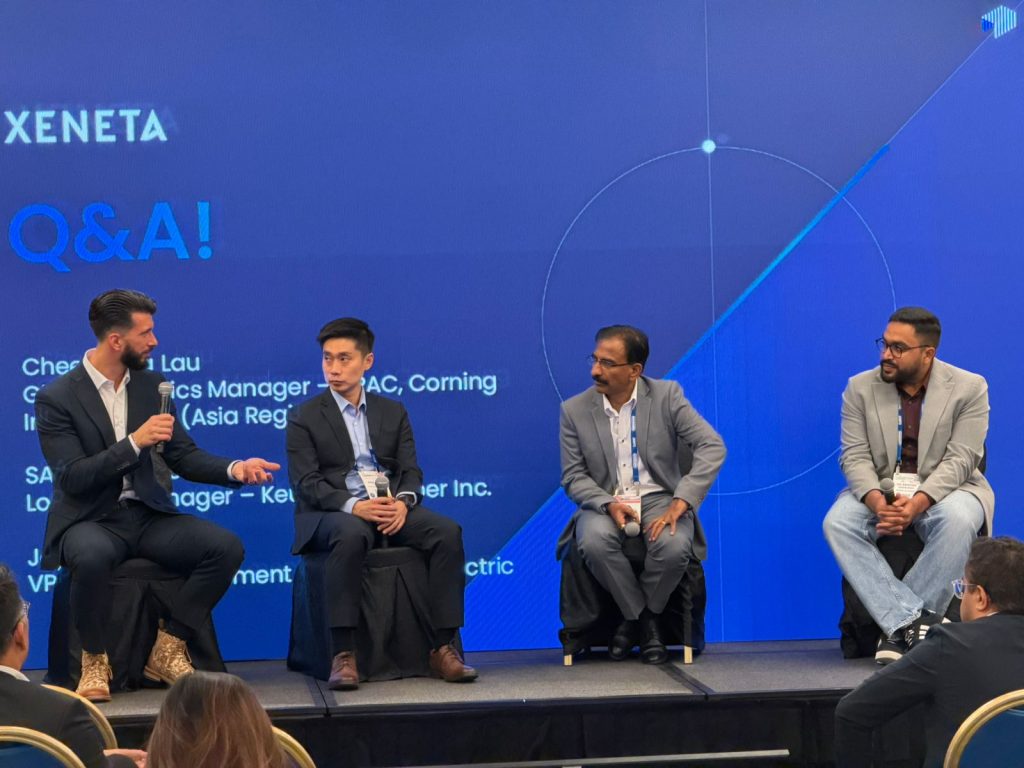
The LSCMS Shippers’ Council we unite BCOs, Logistics leaders, and industry experts to turn insight into action and stay ahead in a volatile market. Through collaboration, benchmarking best practices, and focused discussions, we drive smarter, more resilient supply chains. At LogiSYM Asia Pacific, in May, the Council had the opportunity to participate in a closed dorr roundtable with Xeneta to discuss and explore how strategic insights and tools provide a strategic leverage for shippers to leverage
Ocean freight procurement has fundamentally changed. What was once a relatively stable function driven by annual tenders and carrier relationships has evolved into a highly volatile, data-intensive strategic discipline.
Over the past few years, supply chains have been tested by an almost continuous sequence of disruptions: COVID-19, the Ever-Given blockage of the Suez canal, the Ukraine-Russia war, Panama Canal drought, Red Sea crisis, labour strikes, tariffs, and now Middle East instability.
As highlighted during the recent “Market Intelligence Deep Dive: From Data to Boardroom Leverage” session conducted with Xeneta at LogiSYM Asia Pacific 2026 in partnership with the LSCMS Shippers Council, disruption is no longer an exception, it is the operating environment. In fact, schedule reliability remains structurally weak, hovering around ~30–36% in early 2026, with persistent delays of 3–5 days across key trade lanes.
In this environment, the biggest risk for shippers is not simply high freight rates. It is the lack of visibility and the inability to convert market intelligence into strategic action.
One of the strongest messages from the session was that benchmarking must evolve beyond a procurement reporting tool. Historically, benchmarking was often used retrospectively: to validate whether rates were “good” or “bad” versus the market. Today, leading organisations are using benchmarking proactively to answer boardroom-level questions:
- What should we budget for next year?
- Are we paying above market?
- How exposed are we to volatility?
- Are we balancing cost and reliability correctly?
This shift is important because executive leadership teams do not think of freight percentiles or rates in isolation. They think in terms of business impact: margin protection, risk exposure, inventory continuity, and cash flow predictability.
Another important discussion centered around early-warning indicators. Freight markets rarely move without signals. Rising blank sailings, widening spot-contract divergence, port congestion, and fuel surcharge escalation often precede major market shifts. The session demonstrated how market intelligence can help shippers react earlier rather than simply respond after costs escalate. For example, rising blank sailings and congestion levels, reaching as high as 80–100% vessel waiting ratios at some Middle East ports have acted as leading indicators of supply chain stress in 2026.
The session also emphasised that rate benchmarking alone is no longer sufficient. Carrier scorecards are becoming increasingly critical. In volatile markets, the cheapest carrier may not be the most cost-effective option when schedule reliability deteriorates. Xeneta demonstrated how organisations are increasingly combining freight rates with operational metrics such as transit time, blank sailings, congestion trends, and on-time performance to make more balanced sourcing decisions and business review discussions more effective.
This is particularly relevant as reliability remains fragile across many trade lanes despite temporary improvements. The traditional procurement focus on minimising freight rates is gradually shifting toward optimising total supply chain cost and resilience.
One of the more forward-looking topics discussed during the session’s panel discussion centered around index-linked contracts and freight futures. In volatile markets, fixed annual contracts can quickly disconnect from market realities, creating pressure for both shippers and carriers. Index-linked models offer a more transparent and dynamic approach by aligning rates to market benchmarks, improving predictability and reducing extreme contract dislocations. However, they do not eliminate exposure to market swings. This is where freight futures and derivatives could play an important complementary role. Like fuel hedging, freight futures may provide shippers with an additional financial risk management layer to protect against sharp volatility while maintaining operational flexibility through index-linked procurement strategies. Though in its early stages, the evolution is already taking shape with regulated container freight futures now available across key trade lanes, enabling shippers to hedge exposure in a more structured and transparent way.
This represents a significant evolution in freight procurement thinking: moving from purely operational sourcing toward portfolio-based risk management.
Perhaps the most important takeaway from the session was this: Data alone does not create leverage. Decision quality does. Organisations that systematically combine benchmarking, carrier performance intelligence, early-warning indicators, and structured risk management strategies will be better positioned to navigate future disruptions.
Membership in the LSCMS Shippers Council is open to all major BCO’s. for more information contact Edmund Lee at elee@lscms.org
About the author

Sai Krishna SBS
Logistics Manager · Keurig Dr Pepper