


Globalised trade delivers efficiencies but also creates long, vulnerable chains. The COVID‑19 pandemic, geopolitical conflicts and extreme weather exposed how quickly lean networks can seize up, while tariffs and tensions continue to erode margins¹. The OECD stresses that resilience is about navigating uncertainty through cooperation and adaptation rather than eliminating all risk². This article distils recent research on why supply‑chain resilience matters and how organizations can strengthen it through risk assessment, compliance and strategic investment.
Why supply‑chain resilience matters
Supply chains underpin modern commerce. Sixty percent of global trade consists of intermediate goods², so a disruption in one region quickly echoes elsewhere. During the pandemic, reliance on a handful of suppliers meant that factory shutdowns rippled across industries¹ ². Companies added buffers, but unrestrained reshoring or stockpiling can erode profits; BCG estimates that tariffs and geopolitical tensions threaten up to 20–30 % of manufacturing EBIT¹.
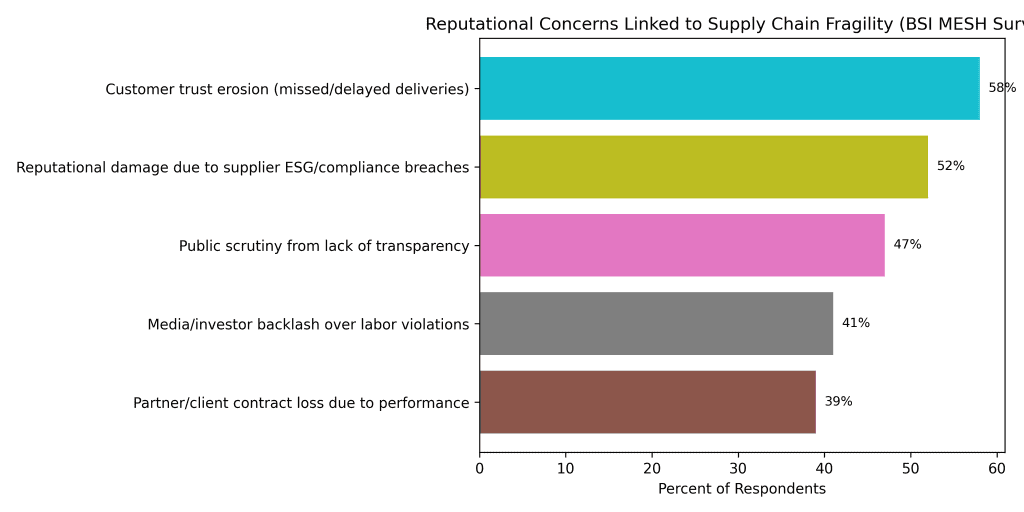
Surveys indicate that many firms are ill‑prepared. The BSI MESH 2025 report found that more than 60 % of organizations are Basic or Ad Hoc in resilience and only 6 % are leaders³. Only 38 % have end‑to‑end risk visibility, fewer than one‑third provide regular risk training³ and over half experienced major disruptions without updating plans³. Another survey by WTW shows fewer than 8 % of businesses feel in control and 63 % have suffered higher‑than‑expected losses⁴. These weaknesses have reputational consequences: 58 % worry a failure will erode customer trust and 52 % fear damage from supplier ESG breaches³. Growing regulations such as the EU’s Corporate Sustainability Due Diligence Directive require firms to identify and prevent human‑rights and environmental harms across their value chains⁵. Resilience, compliance and brand equity are therefore intertwined.
Corporate resilience and agility
Corporate resilience is the ability to absorb shocks; agility is the capacity to pivot quickly. Before 2020, supply‑chain design prioritised efficiency lean inventories and single sourcing¹ leaving companies exposed to sudden disruptions. After the pandemic, many diversified suppliers and carried more buffers, but simply duplicating capacity is costly. BCG recommends a cost‑of‑resilience mindset: build capabilities such as risk forecasting, automation and climate analysis that can flex to disruption without destroying margins¹. The OECD’s “Three A” principles – agility, adaptability and alignment guide this effort². Agility allows quick rerouting and switching; adaptability enables longer‑term shifts like regionalising production; alignment ensures that suppliers and regulators share incentives. Flexible contracts, cross‑trained workers and transparent data help operationalise these principles, while supportive policies on trade and digitalisation create an enabling environment².
Risk assessment: identifying and quantifying vulnerabilities
Resilient supply chains start with rigorous risk assessment. Mapping beyond Tier 1 exposes hidden dependencies, yet only 29 % of companies maintain formal risk registers and 22 % update mitigation plans more than once a year³. The biggest threats identified by the MESH survey were supplier failure (63 %), regulatory or ESG non‑compliance (49 %), logistics delays (46 %), data gaps (38 %) and political instability (34 %)³. A bar chart³ summarising these priorities appears below.

Quantifying impacts matters. Research suggests that major disruptions cost roughly US$1.5 million per day⁵, with high‑tech industries losing even more. Eighty‑one percent of companies reported supplier disruptions in the past two years, and nearly 30 % of incidents cost over US$5 million⁵. Such stakes justify investing in models that estimate expected losses and test mitigation strategies. Digital tools enhance this process: AI systems monitor weather, geopolitics and logistics to predict disruptions⁶, while analytics combine supplier financial health and social‑media sentiment to identify weak spots. Dashboards and digital twins provide a holistic, real‑time view of operations for scenario modelling.
Compliance and reputational risk
Compliance now covers ESG standards, human‑rights due diligence and data security. Thirty‑five percent of firms cite regulatory or ESG scrutiny as a major risk³, and 52 % fear reputational damage from supplier breaches³. Regulations like the EU CSDDD oblige companies to identify and mitigate adverse impacts across their value chains⁵. To manage these risks, businesses embed due diligence into supplier selection and monitoring. Platforms such as Avetta integrate contractor management with compliance oversight⁶, Sedex provides ESG‑risk analytics⁶, and financial institutions offer insight on how credit and regulation affect supply continuity⁶. Blockchain and AI tools capture provenance data and scan for non‑compliance signals. Using these technologies reduces the likelihood of fines and protects brand value.
Opportunity cost: balancing cost and resilience
Resilience investments cost money but ignoring them can be far more expensive. BCG notes that tariffs and geopolitical tensions could erode 5–7 percentage points of margins for automakers and up to 30 % of EBIT in some manufacturing sectors¹. WTW still found that 63 % of firms experience higher‑than‑expected losses⁴. Rising risks for 2025 include geopolitical turmoil and inflation, with cyberattacks and regulatory changes close behind⁴. Modelling these risks helps determine the right mix of dual sourcing, extra inventory or insurance. Opportunity costs also stem from complacency: many resilience programmes are siloed within procurement³. As companies shift toward executive oversight and dedicated risk teams⁴, embedding metrics like recovery time and inventory flexibility into dashboards ensures resilience becomes a core performance measure.
Building resilient and agile supply chains
Strengthening supply‑chain resilience requires a blend of technology, relationships and governance. End‑to‑end visibility is critical: digital twins and AI dashboards provide real‑time transparency across tiers, and AI adoption is accelerating⁵. Supplier diversification reduces dependency on single sources; multi‑sourcing, regional production and shared capacity models spread risk¹. Collaboration platforms facilitate information sharing and contractor management⁶. Compliance and sustainability must be embedded into sourcing data platforms like Sedex provide ESG risk data⁶, and the EU’s CSDDD mandates due diligence⁵. Workforce capability is often a blind spot³; cross‑functional risk teams, scenario planning and training build preparedness, while clear governance assigns responsibility⁴. Scenario testing and dynamic safety‑stock models help manage physical disruptions¹. Financial hedging and insurance offer buffers against currency swings, commodity shocks and climate events, providing a safety net especially given that few firms feel fully in control⁴.
To visualise reputational concerns, the chart below³ summarises what respondents fear most when supply chains break. Loss of customer trust (58 %) and reputational damage due to ESG breaches (52 %) stand out³. Public scrutiny, investor backlash and contract loss are also significant.
Conclusion
Building resilient supply chains is no longer optional. The pandemic, geopolitical tensions and climate events have exposed the fragility of over‑optimised networks. The OECD emphasises that resilience is about navigating risk rather than eliminating it², while BCG reminds us to consider the cost of resilience relative to potential losses¹. Surveys from BSI and WTW reveal that most organisations lack comprehensive visibility, formal risk registers and workforce capability³, yet disruptions and reputational risks are growing³. Firms that invest in risk assessment, integrate compliance, diversify suppliers, embrace digital tools and foster agile cultures will turn resilience from a cost centre into a competitive advantage. Ultimately, resilience must become a shared responsibility across the value chain: suppliers, customers, regulators and investors all have a role to play. Companies that align incentives and treat resilience as a strategic asset will be best positioned to weather future shocks and seize emerging opportunities.
Resilience is also a catalyst for value creation. Enhanced visibility and digitalisation can reveal inefficiencies and improve forecasting. Sustainable sourcing and transparent data appeal to customers and investors, strengthening brand loyalty. Cross‑functional collaboration encourages innovation and helps companies adapt to changing consumer preferences. In a volatile world, firms that embed resilience into their strategy not only reduce risk but also unlock growth.
References:
¹Cost and Resilience: The New Supply Chain Challenge | BCG https://www.bcg.com/publications/2025/cost-resilience-new-supply-chain-challenge
²OECD Supply Chain Resilience Review (EN)
³MESH Supply Chain Resilience Report 2025
⁴Global Supply Chain Risk Report 2025 – WTW, https://www.wtwco.com/en-ng/insights/2025/05/wtw-global-supply-chain-risk-report-2025
⁵Top 30 Supply Chain Statistics for Leaders in 2025, https://www.clickpost.ai/blog/supply-chain-statistics
⁶Navigating Risk and Building Resilient Supply Chains in 2025 | Procurement Magazine
https://procurementmag.com/news/building-supply-chain-resilience-in-2025
About the author

Kim Winter
Founder & Group Managing Director · Logistics Executive Group