

Tariffs have been a moving target all year long for companies importing into the US, creating levels of uncertainty that inhibit decision making while raising long term questions about strategy in the face of a world order where a longtime global consensus on the value of trade no longer applies.
Irrespective of how the US Supreme Court rules on the Trump administration’s use of the 1977 International Emergency Economic Powers Act to justify significant increases in tariffs – oral arguments were held on 5 November and a decision could come quickly – the landscape for companies has irrevocably shifted.
This has played out in the context of the US-China bilateral relationship. The year has seen growing evidence of decoupling in containerized trade, as companies importing into the US accelerated re-shoring while China in turn re-oriented its exports to destinations separate from North America.
Containers handle roughly 45% of global trade by value, according to UNCTAD. And this year saw a visible acceleration in re-shoring of US sourcing away from China as visible through container trade flows.
China’s market share in US containerized imports 2025 year to date through September dropped 4.1 percentage points to a multi-year low of 36.2%, the biggest drop during that 9-month stretch that has been recorded over the past decade, according to S&P Global Market Intelligence.
During that period Vietnam, the big winner, saw its share of US containerized imports increase from 9.8% to 11.7% while India, Thailand, Indonesia, Malaysia, Cambodia, Bangladesh also saw market share gains, albeit smaller.
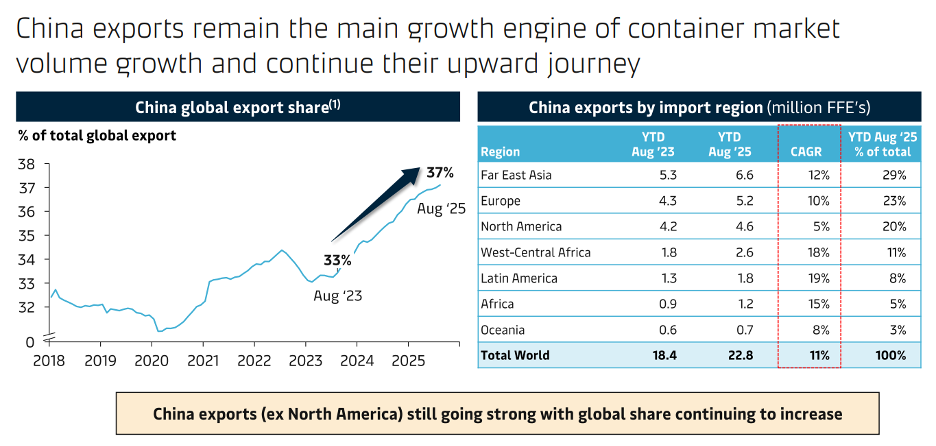
At the same time, China reoriented its exports away from the US, significantly ramping up its global market share on exports over the past two years as well as its export growth to all regions of the world apart from North America.
For example, China’s global market share of exports shot up from 33% to 37% between August 2023 and August 2025, according to data shared by AP Moller-Maersk as part of its 3Q earnings release on Nov. 6.
Source: https://investor.maersk.com/financials/financial-reports
During this two year period cumulative annual growth in volumes from China grew 12% to Far East Asia, 10% to Europe, 18% to West/Central Africa, 19% to Latin America, 8% to Oceana but only 5% to North America.
“China’s export growth into all regions of the world, except for North America, has not only been resilient, it had gathered pace,” Maersk CEO Vincent Clerc told investors on Nov. 6. “China’s share of global export has increased significantly and never as fast as it has over the past two years.”
“The fabric of global trade is changing,” Clerc had told investors back in August. “If you just look at the numbers, what we’ve seen in the last two and a half years is an acceleration of globalization on the back of huge commercial success from Chinese companies that are taking market share on the global stage.”
This took place in the context of a buoyant global economy that defied the shock of US tariffs given that no country followed the US down the road of trade conflict.
Estimates for global GDP growth in 2025 was raised in October from 2.6% to 2.7%, according to S&P Global Market Intelligence. “Global economic conditions have been resilient to trade-related uncertainties,” the firm said in its latest Global Executive Summary published on Oct. 16.
“We continue to forecast a near-term moderation in growth momentum in most major economies and regions, primarily due to a hangover from prior tariff front-loading,” the forecast said. “This is not expected to turn into a slump in 2026 thanks to a few tailwinds for growth. These include further falls in crude oil prices, feeding into lower inflation rates and more accommodative monetary policies.”
The upheaval in trade from US tariffs is clearly visible in container shipping dynamics that point to a diversification in trade requiring full fleet utilization despite growing signs of overcapacity. Spot freight rates on a global basis are down 50% since the beginning of the year, according to the Drewry World Container Shipping Index. Yet idling and scrapping remain minimal and charter rates and second-hand ship prices remain strong.
The idle fleet was “remarkably low” Alphaliner said on 3 November, currently pegged at 0.9% of total global capacity. “Despite market pressure, the idle fleet remains minimal, signaling robust vessel utilization,” Alphaliner said in October.
This reflects a fracturing of the longtime dominance of traditional east-west trade lanes into multiple smaller and faster growing trade routes including those two and from Africa, as reflected in the data shared by Maersk. Ships as large as 24,000 TEUs are now calling at ports in West Africa. But in many cases these cross-trades require smaller ships that have not been turned out by shipyards at the same pace as mega-vessels over the past decade, hence the robust demand as reflected in charter rates and lack of idling and scrapping in 2025.
At the same time, although North America was the slowest growing region for China trade in the Maersk data, there is a view among some industry leaders interviewed in October that the trans-Pacific trade lane may not remain quiet for too long.
The lack of congestion seen at major US import gateways such as Los Angeles-Long Beach in 2025 is seen by some industry leaders as evidence of fluidity at warehouses — where the 2022 backups originated. In other words, inventory, instead of being stockpiled this year due to frontloading of imports to avoid tariffs, is instead flowing down the supply chain through to final sale.
According to investment bank Jefferies, that means when it comes to US imports, “recovery is likely in 2026.”
US imports from Asia dropped almost 12% in September year over year after being on a record pace earlier in the year, according to PIERS, a sister company of the Journal of Commerce within S&P Global Market Intelligence. Imports are forecast to continue to decline for the remainder of this year and into early next year.
Some, however, believe the frontloading story of 2025 was overplayed — the message being that destocking is actually the major theme this year, which will result in a more robust 2026. In other words, while importers sought earlier in the year to get goods into the country ahead of potentially steeper tariffs imposed later in the year, in reality most goods actually brought into the US flowed down the supply chain through to final sale.
“Another ‘muted’ peak season in 2026 seems unlikely, given inventory levels,” Jefferies wrote in a research note Tuesday. “Thus, we can see a healthier market on the trans-Pacific [next year].”
“In the first quarter of 2026, there will be a mini revival similar to COVID in terms of volumes,” said a senior US-based carrier executive. “Warehouses are depleted and you can see some real movement of volume, and space will become tight.”
Others have noticed that inventories in the US are not bloated, nor is the country in recession, thus supporting the potential for an early year bounce back in trans-Pacific volumes.
Inventory-to-sales ratios for retailers — which have hovered between 1.28 and 1.32 this year, according to the US Bureau of Economic Analysis — suggest that businesses “are holding leaner inventories than expected amid the frontloading narrative,” Maersk said in an Oct. 1 market update. Inventory-to-sales ratios compare the value of a company’s inventory to net sales and provide a measure of how quickly inventory moves off the shelf.
That is leading to optimism in some segments of the supply chain, such as warehouse space.
“Demand has clearly turned a corner. The market is in an inflection point,” Christopher Caton, senior vice president and global head of research at Prologis, Inc. told investors on Oct. 15, as reported by CapIQ Pro.
About the author

Peter Tirschwell
Vice President · Journal of Commerce by S&P Global