
By Brett Marshall, Editor-In-Chief, LogiSYM Magazine
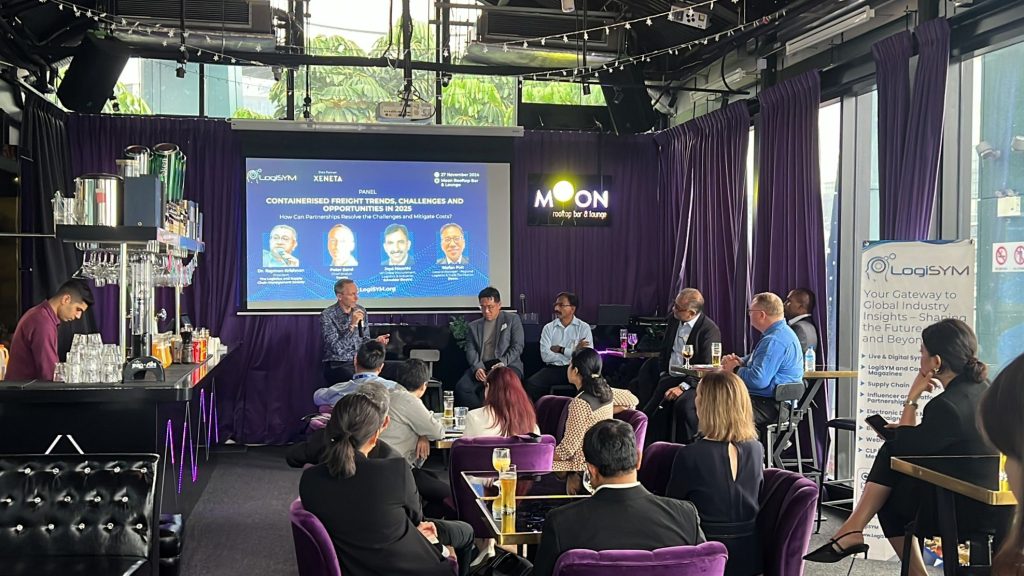
The LSCMS Shippers Council met on 27 November. The focus for the meeting centred around Containerised Freight Trends, Challenges, and Opportunities in 2025.
The group of senior Logisticians was provided with excellent insights fromPeter Sand, Chief Analyst with Xeneta.
Referring to Xeneta’s Market Rate Outlook 2025, Peter analysed the Far-East-Mediterranean route projecting long term rates coming off an August peak, to trend lower at 6% from where it is today, albeit with continued influence of Red Sea-related issues. On Trans-Pacific with a 2-year perspective, while short-term rates particularly spiked through Q3 2024, the 3-month average for long-term rates has remained lower.
2025 will see 3% more boxes moved, but TEU miles could drop 11% without Red Sea disruption.
Peter discussed potential Trump impact in 2025 with comparisons to the first Trump presidential term, with similar patterns in 2016 of the front-loading and inventory build currently. TEU demand was at a low point in 2022 and peaking in Expected 2024, with a slight drop in Forecast 2025.
Far-East-Mediterranean 2025 TEU miles will continue to reflect the influence of Red Sea with limited upside for containerships in scenarios considered between “No Return” and “Full Return”.
The geo-political and regional disputes that influenced 2024 will continue in 2025, Peter noted that in the US, the ILA has yet to sign the agreed pay deal and 15 January, 2025 could see a repeat of “right to strike” exercised.
Global container volumes peaked in August 2024, and despite a slowing of demand, remained the highest September on record. TEU capacity is showing 10% growth in 2024 and expected at 6% in 2025. While there are major changes to the Alliances taking place in 2025, MSC alone is projected to add nearly 600,000 TEUs.
Peter wrapped up his presentation looking through the ESG lens, there has been a significant increase in carbon emissions on the back of Red Sea disruption. There no further regulatory changes anticipated in 2025.
The presentation was then followed by interactive panel session, moderated by the President of the Logistics and Supply Chain Management Society, Dr. Raymon Krishnan, and with Peter Sand joined by fellow panellists Jaya Moorthi, VP Global Procurement – Logistics & Industrial, Schneider Electric, and Stefan Pun, General Manager – Regional Logistics and Trade Facilitation, Denso. It was an interactive and thought provoking session with some of the key takeaways being:
- Adapting to the mindset of “Polycrisis” and preparing to future-proof supply chains through agility to adapt and mitigate, with a clear understanding of both risk and probability, and quickly pivot to mitigating options available;
- The need to look at supply chain costs from an end-to-end perspective rather than shipment costs alone;
- Ensure there is a clear understanding of trigger points to take action
- Volume alone can no longer be the sole determinant of partner relationships as strength and trust with partners are key to addressing “Polycrisis”.
About the author

Brett Marshall
Editor in Chief · LogiSYM Magazine