

Ashima Tyagi
Economics Associate Director – Pricing and Purchasing S&P Global Market Intelligence
With President of the United States (U.S.) Donald Trump having marked his first 100 days in office in April, global procurement leaders are confronting a rapidly evolving environment characterized by increasing concerns over input cost escalation, possible supply chain disruptions and a risk of slowing growth across several economies. While there has been a relative easing of the geopolitical trade tensions in May, especially between the U.S. and mainland China, companies still need to reshape their supply chain strategies in real time and adapt swiftly to this new reality where uncertainty prevails. The interplay of rising protectionism globally, tariffs in the U.S. and trade negotiations from other trade partners have created a scenario where businesses are not merely forecasting disruptions; they are experiencing them firsthand and adjusting their operations accordingly.
The Decline of the “China Plus One” Strategy
In the first week of April, President Trump enacted a tariff policy that established a 10% baseline universal tariff on most imports into the U.S., barring some exemptions, alongside significantly higher reciprocal tariff rates for specific trading partners. The reciprocal tariffs are now paused until July 9. While these measures are intended to strengthen the U.S. manufacturing and lessen dependence on foreign supply chains, they have inadvertently hindered the diversification strategies that businesses had previously adopted during President Trump’s first term. This includes the “China Plus One” strategy, which aimed to encourage companies to diversify their manufacturing operations beyond mainland China, targeting countries like Vietnam, India, Mexico and Taiwan as viable alternatives. However, the proposal to levy reciprocal tariffs—46% on Vietnam, 32% on Taiwan, and 26% on India— has significantly diminished the strategic advantages that initially made these nations attractive options. With the U.S. & mainland China coming to an agreement May 12 to reduce tariffs on each other, the tariff differentials between the “alternative” countries and mainland China are less compelling to incentivize a shift in production base.
The proposal to levy reciprocal tariffs has also made it evident that the administration’s priorities have shifted from minimizing reliance on mainland China to focusing on reducing the U.S. trade deficit with partner nations. As a result, countries that previously gained from trade policies during the first Trump administration are at a risk of other new trade measures from the U.S., even if the reciprocal tariffs are not eventually imposed in July.
The existing 10% baseline tariffs, coupled with the reciprocal tariffs in July, have established a burdensome and complex cost structure for imports into the U.S., regardless of their country of origin. This situation hampers the financial motivation for companies to relocate their production facilities, for cost savings are reduced and heavy capital investment is necessitated. The uniformity of these trade barriers challenges the geographic risk mitigation that previously fueled diversification strategies. Unless several of these “alternate” countries can successfully negotiate trade agreements with the U.S. before the high reciprocal tariffs take effect, the rationale for diversifying production across Asia will
remain tenuous.
Increased Costs and Operational Uncertainty
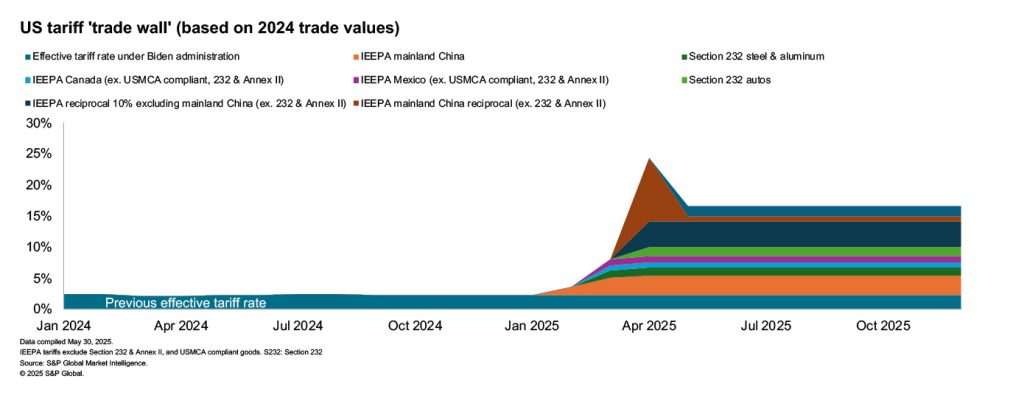
The tariffs have introduced significant challenges for procurement teams and is a significant risk for businesses world over. Companies based in the U.S. are now facing elevated expenses regardless of their sourcing locations, while exporters in Asia are grappling with demand destruction. The effective tariff rate on imports to the U.S. has increased substantially over the past four months rising from 2% to
Over 15% in June. (see Chart below). For labor-intensive sectors like apparel and footwear, these high import costs substantially reduce the savings derived from cheaper overseas production for the U.S. companies, primarily owing to lower wage rates. Relocating supply chains demands substantial upfront investment, but with tariffs broadly applied, the return on such investments remains uncertain.
Additionally, the lack of long-term clarity regarding these tariffs has led to expectations of renegotiations and adjustments of the reciprocal tariff rates. This uncertainty hampers decision-making, as businesses formulate mitigation strategies when tariff regulations may shift within months. For instance, the uncertainty surrounding the fluctuating tariff policies is also impacting the traditional schedule for annual service contracts between ocean carriers and importers in the eastbound trans-Pacific trade, as per S&P Global’s Journal of Commerce (JOC). Typically, these contracts are finalized by May 1 each year; however, sources have indicated to JOC that this timeline has been postponed by at least two weeks. This delay is attributed to confusion regarding the implications of tariffs and the ongoing trade conflict between the U.S. and mainland China, which is creating apprehension about future commercial activities on this critical trade route for the next year.
Looking forward, there is a risk of fragmentation of global trade into competing blocs, one led by mainland China and another by the U.S., despite their reconciliation on reciprocal tariffs lately. Instead of diversifying, countries may prefer to retreat to regional alliances like the Regional Comprehensive Economic Partnership ( RCEPA), The Association of Southeast Asian Nations (ASEAN), BRICS (Brazil, Russia, India, China, and South Africa), amongst others which provide much more policy stability. This trend toward regionalization reduces reliance on true diversification, as firms prioritize predictable trade environments over geographic spread.
Shifting Toward Regionalisation Instead of Diversification
The impact of impending tariffs is likely to adversely affect companies that relocated production to Southeast Asia or India, as they now face sunk costs with diminished returns. For production destined for the U.S. markets, increased tariffs on U.S. imports will lead to price hikes, which can dampen demand for goods sourced internationally. U.S. retailers may choose to stop stocking certain products altogether, as price-sensitive consumers resist higher-priced imports. Businesses are faced with the dilemma of either raising prices (and losing customers) or discontinuing product lines—neither option encourages further diversification.
2025 could prove to be the start of a shift toward regional trade hubs rather than global diversification. For instance, Chinese manufacturers could reinvigorate focusing on countries aligned with the Belt and Road Initiative, which offer lower tariffs and political alignment. This regional consolidation reduces exposure to U.S. tariffs but deepens reliance on fewer, albeit more stable, partners.
Shifting Toward Regionalisation Instead of Diversification
In today’s complex global landscape, leaders are transcending a superficial discourse of resilience and instead are cultivating intelligence around reassessing their exposure to pricing risks emanating out of the tariff-ridden era that we find ourselves in. The evolving nature of tariffs has created an environment where the attractiveness of supply chain diversification has reduced, particularly with new barriers from the U.S. that create intricate cost structures; APAC exporters now face effective rates exceeding 25%, unless reciprocal rates and universal 10% base rates are revoked, necessitating an urgent re-evaluation of the U.S.-centric business models.
Furthermore, the permanence of cost volatility demands a multidimensional approach to sourcing and pricing, incorporating origin, tariff, and currency risks, thereby rendering traditional cost-optimisation strategies obsolete. It is crucial to recognise that diversification does not equate to resilience, as bilateral trade tensions and regulatory fragmentation weaken conventional methods, prompting a shift toward managing supplier risk tiers rather than geographical factors. Additionally, the operational complexities introduced by tariffs, exchange rate fluctuations, and customs risks can serve as strategic advantages, urging companies to embed geo-risk modelling into their decision-making processes.
Finally, the fragility of demand, compounded by currency risks as multipliers, creates unpredictable purchasing environments driven by inflation and fiscal policy shifts, necessitating dynamic pricing models that are adaptable on a regular frequency.
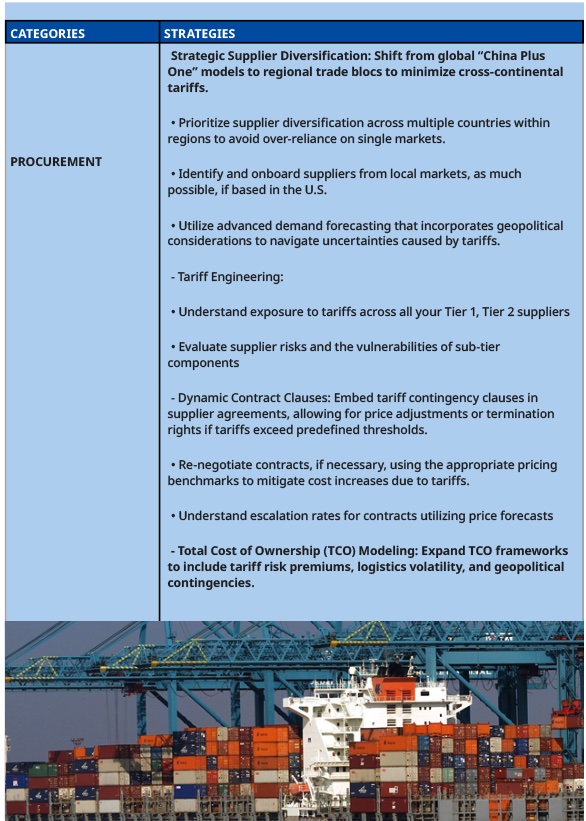
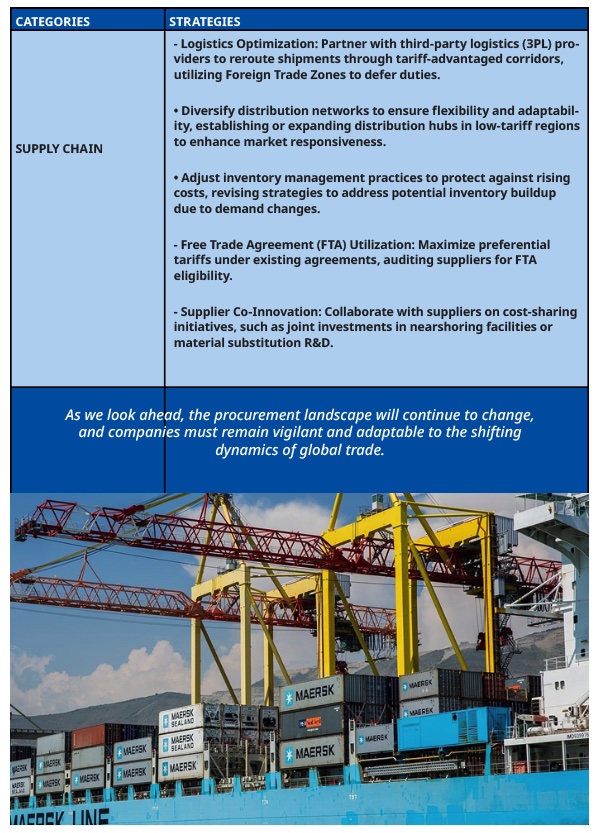
Strategies for Procurement to Navigate Pricing Risks
By imposing uniform barriers to the U.S. markets and fostering policy unpredictability, these tariffs have disincentivised investments in global supply networks. In this evolving landscape, procurement teams must implement agile, multi-faceted strategies that balance cost containment with supply chain resilience. By transitioning from global “China Plus One” models to regional trade blocs, modifying product designs to qualify for lower tariff classifications, and incorporating dynamic contract clauses in supplier agreements, businesses can better position themselves to thrive in a tariff-heavy environment. Unless tariff structures stabilise and exclude key partners, the era of aggressive diversification may give way to a focus on localised resilience—a transformation that could redefine globalisation for years to come.
About the author

Ashima Tyagi
Economics Associate Director, Asian Pricing & Purchasing · S&P Global Market Intelligence